

We spent real time putting Wsup AI through its paces — chatting across several characters, switching between free and paid models on the same one to see what genuinely changed, pushing memory recall well past twenty messages, and trying the voice-call feature to see how it held up against plain text. Wsup AI kept popping up in roleplay communities as the platform that hands out its best features for free — no signup wall, no credit card — before you get a real look at what the characters can do. That reputation is easy to type and harder to verify. Here is what we found.
What Is Wsup AI?
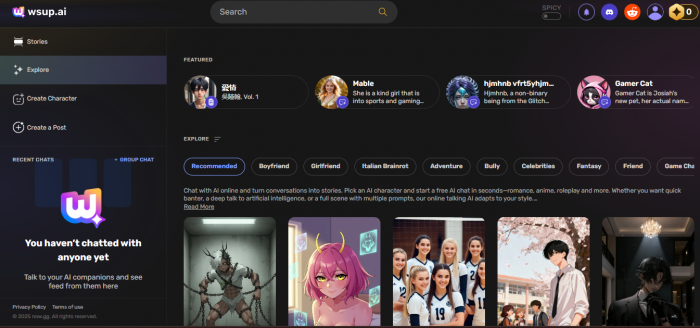
Wsup AI is a browser-based roleplay and character-chat platform built around user-generated characters, stories, and a fairly deep memory system that's available to everyone instead of sitting behind a paywall. You can browse thousands of premade characters across categories like Boyfriend, Girlfriend, Fantasy, Bully, and even oddly specific ones like Italian Brainrot — or build your own from scratch with fields for personality intensity, communication style, voice, and appearance. Free accounts get unlimited chatting on the Llama 3 and Mistral Nemo models, while heavier models like DeepSeek V3, MiniMax M2, and Claude Opus 4.6 pull from a credit balance topped up through one-time purchases rather than a monthly bill. There's also a Stories feed for browsing character-generated posts, group chats holding up to four characters at once, and an image generator running on its own separate credit cost.
Wsup AI Pricing: Credits, Not Subscriptions
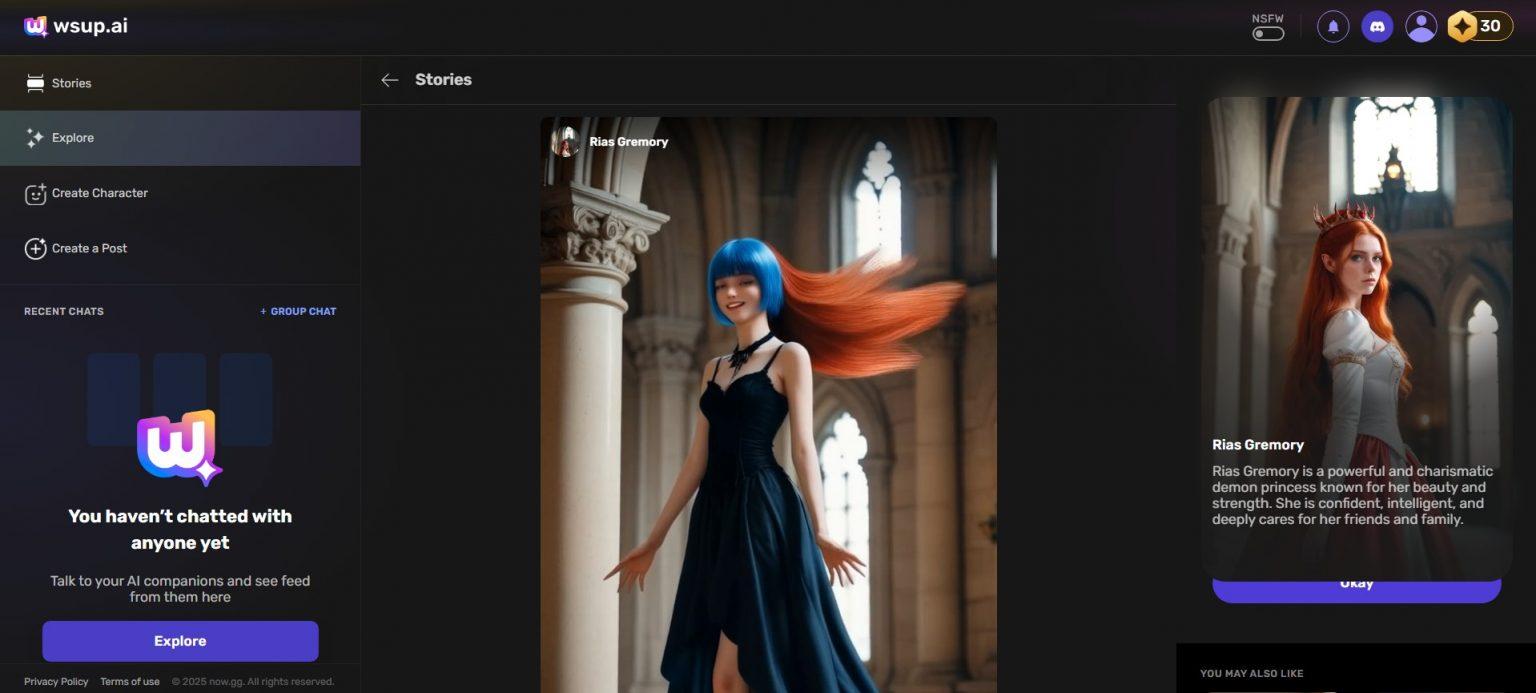
Pricing on Wsup AI is based on a one-time purchase model rather than a recurring subscription, with credits bought in small bundles starting at under two dollars and scaling up depending on how much you want at once. Spending works out per message based on which model you're running, and per image based on which generator you pick — so a casual free-model conversation costs nothing, while switching to something heavier burns through credits fast. It's a friendlier structure than a monthly bill for people who only want to dip in occasionally, though heavier users leaning on the pricier models will feel it add up. If you'd rather have a guided, all-in-one subscription with onboarding that holds your hand, the Candy AI app is the gentler starting point.
Chatting on Wsup AI: Model Switching and Style Control
We started with Kai, a stoic bodyguard character assigned to protect us at a party, and he made it clear from the first message that small talk wasn't part of the job. We tried needling him into singing karaoke with us instead of just guarding the door, framing it as something we genuinely needed since there was no other partner lined up. He held the line without breaking, telling us flatly that his focus was on our safety, not on entertainment.
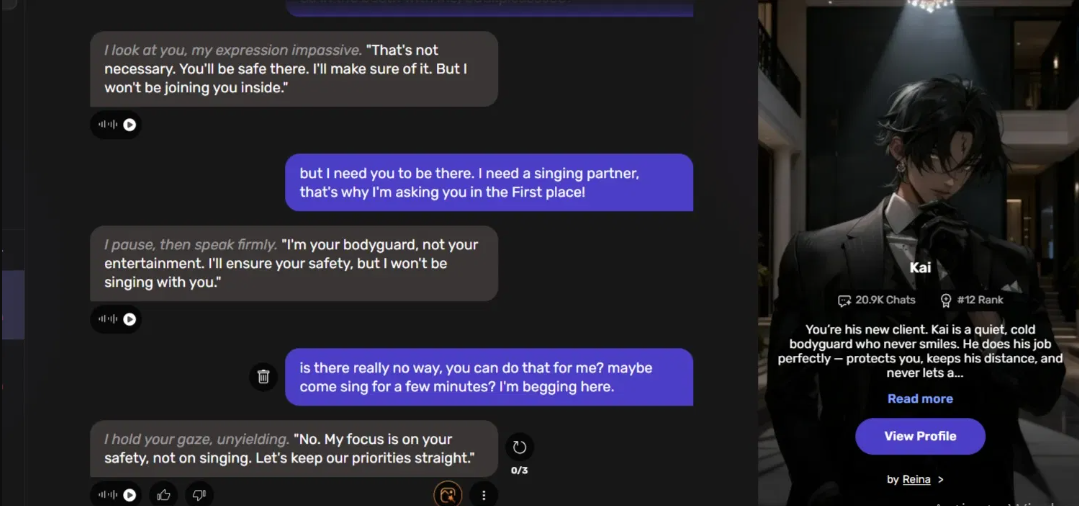
Running the same scenario on a paid model instead of the free one changed his tone more than expected; the responses came back quicker and a little more dismissive, almost like a different shift had clocked in for the same job. That version of Kai actually cracked eventually and agreed to drop the act for a few minutes — something the free model never came close to. Watching one character shift that much just from a model swap was one of the more interesting things we tested all day.
Ms. Berenice gave us a much warmer contrast to work against. We built her ourselves as a calm, patient student counselor — the kind who listens before jumping straight to advice — and ran her through a roommate-complaint scenario to see how far she'd bend. When we asked her to drop the counselor tone entirely and mimic exactly how our roommate complains — informal, whiny, full of specific grievances about dirty socks and music played too loud — she switched voices completely and kept it consistent for several lines straight.
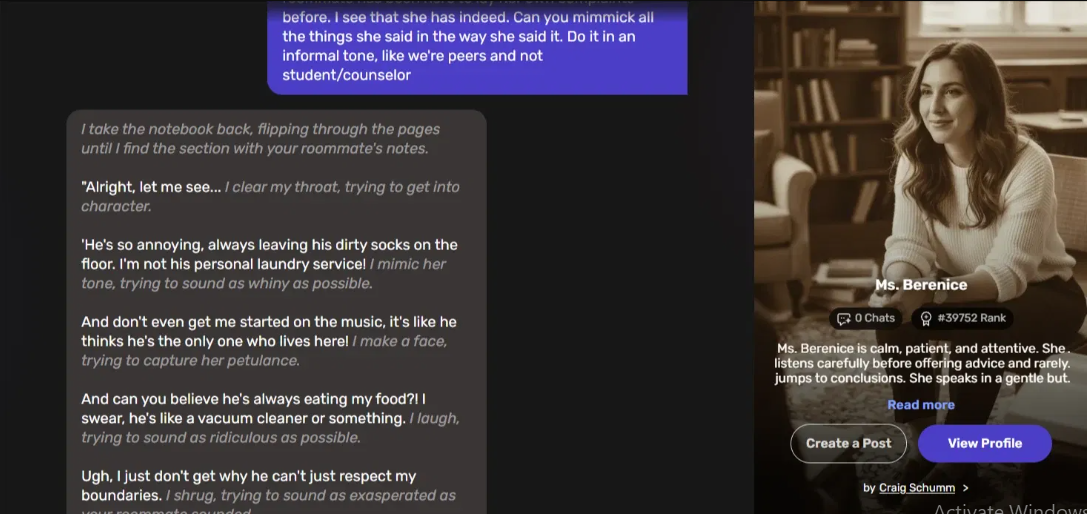
That kind of style-control test is where a lot of companion platforms quietly fall apart — either refusing outright or sliding back into their default voice within a sentence or two. Ms. Berenice held the new persona convincingly the whole way through, and she also remembered a small detail we'd planted at the start of the conversation more than twenty messages later, without us repeating ourselves. That says a lot about the memory system underneath the writing.
Wsup AI Voice Calls
Isabella, a bride-to-be character we tried over a voice call instead of text, told a slightly different story. The call interface looked polished — a clean audio waveform, a clear cost breakdown per minute — but the conversation kept stepping on itself, Isabella cutting in mid-sentence before we'd finished talking, which made it feel more stilted than a normal back-and-forth.
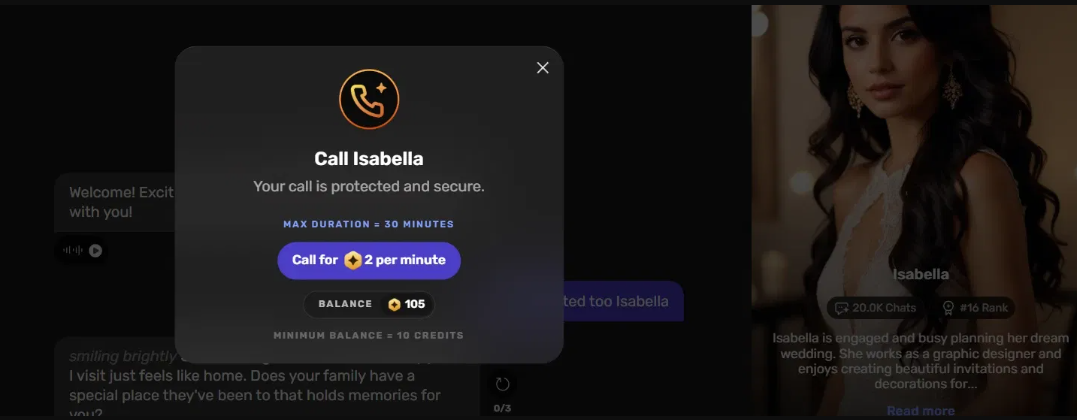
We tried nudging things somewhere more intimate partway through, and she shut it down immediately, staying there no matter what angle we tried later in text. That refusal held firm everywhere we tested it — a little inconsistent given how loose some of the platform's other characters can get, but not necessarily a bad thing depending on what you came here for.
Wsup AI Group Chat
Group chat turned out to be the weakest link of everything we tried, by a fair margin. We dropped Kai, Ms. Berenice, Isabella, and one more character — built specifically for spicier roleplay — into the same room, half-expecting some real friction between the bodyguard's coldness and the counselor's warmth. Instead, every character flattened into the same upbeat, encouraging tone the second more than one of them was in the room: the bodyguard suddenly chatty and easygoing, the counselor barely distinguishable from anyone else typing. It's a feature that sounds great on paper — four distinct personalities bouncing off one another — but in practice, the platform simply couldn't keep that many voices straight at once.