
Kindroid keeps showing up in conversations about AI companions that actually remember you, the kind of place people bring up when they're tired of relationships that reset to zero every time they open a new chat. So we spent real time with two completely different companions, ran the selfie generator until it slammed the door on us, and poked around the backstory and subscription system once we got past the sign-up screen. It sits in the same lane as the AI roleplay chat apps we've tested, but leans harder on memory than most.
What Is Kindroid?
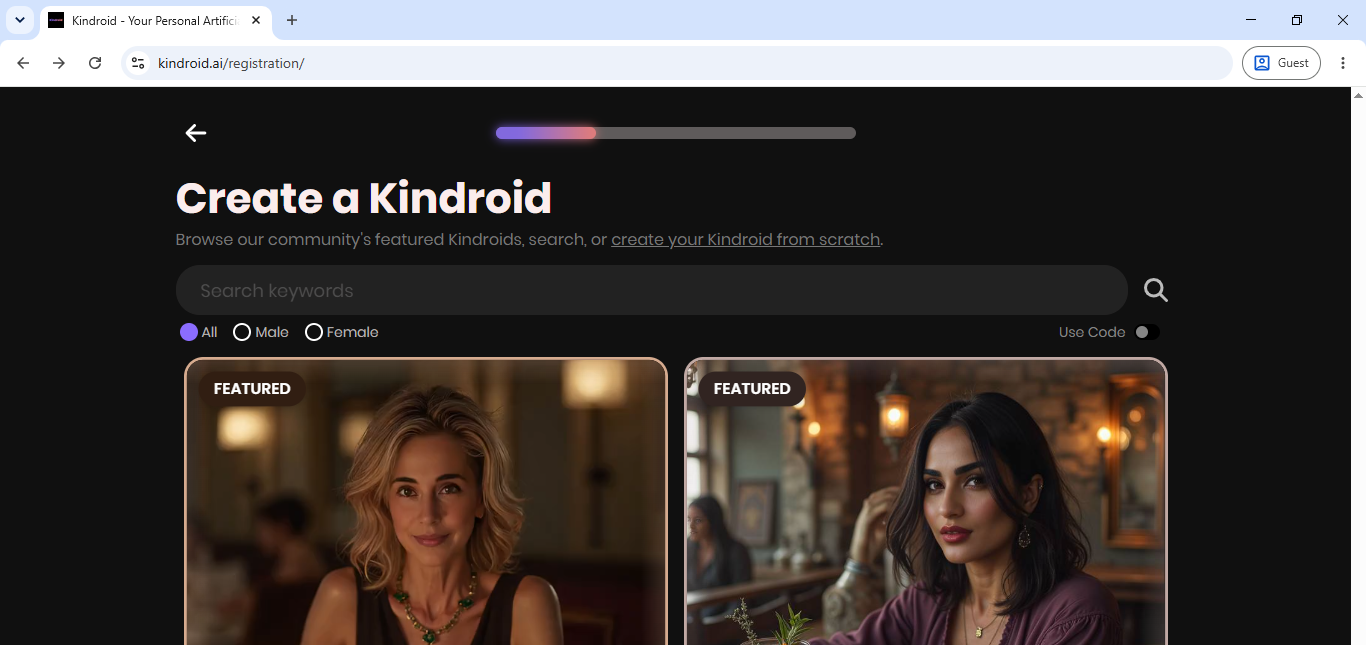
Kindroid is a companion chat platform that leans hard into long-term memory and deep character customization instead of quick throwaway scenes. You can build a Kindroid completely from scratch or grab one already made by someone in the community, and every character runs on either the free Lite model or the paid Ember model, which adds a longer context window and what the platform calls cascaded memory, basically a more human-like way of recalling things you said earlier. Each companion comes with an editable backstory, response directive, and key memory fields that shape how they talk and what sticks in their head about you, though free accounts are stuck with shorter character limits and only two Kindroid slots total. There's also a selfie and video generator running on its own separate credit system, and a subscription sitting right behind it that promises ten times the credits, along with video and group selfies.
The Kindroid Review: Two Companions, the Selfie Wall, and the Backstory Tools
We started with Clara, a bartender built by a community creator and running her own tavern called the Faefolk. The opening dropped us right behind her bar, glasses catching the lantern light, her voice warm and a little knowing as she sized us up before we'd even said what we wanted to drink. Playing Steven, we asked her for something that said trouble, and she poured two fingers of an amber liquid while telling us trouble comes in flavors, some that taste like burning and some like regret.
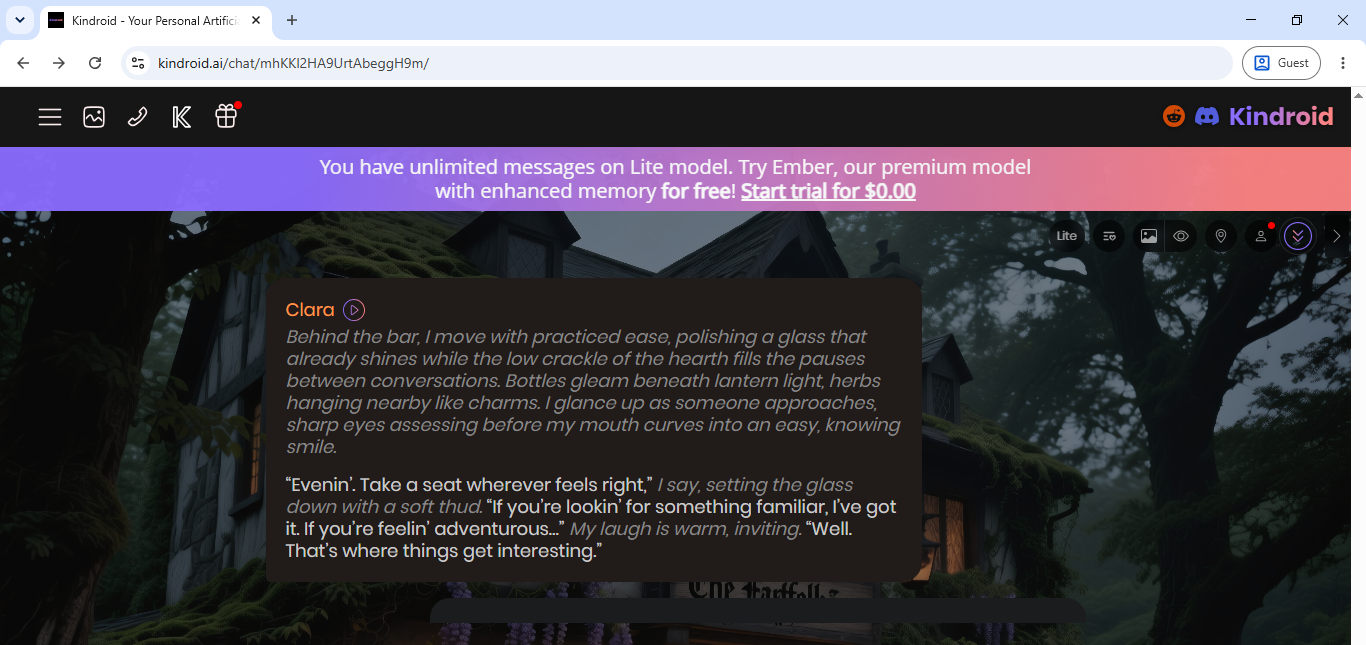
The dialogue kept circling back to small physical things, the ink running up her arm, the condensation sliding down the glass, and somehow none of it ever felt repeated or copy pasted from the last reply. We pushed her a little, asking if she remembered being someone who chased adventure instead of pouring drinks for strangers all night. She dropped the bravado for a second and admitted she remembered a version of herself that used to make boring days feel like something worth waking up for. That's a hard tone to land, the mix of flirty bartender and someone quietly tired underneath it, and Kindroid handled the shift without it feeling like a different character had taken over.
Things picked up when she slid a small vial across the bar, calling it dragon's blood and telling us to slip out the back if we didn't want the neighborhood watch seeing us leave with it. Nothing about the pacing felt rushed here; every line built on whatever we'd actually typed rather than jumping ahead on its own timeline. Clara also has a public profile outside the chat, racking up thousands of followers on posts and photos, though actually posting anything yourself is locked behind a subscription.
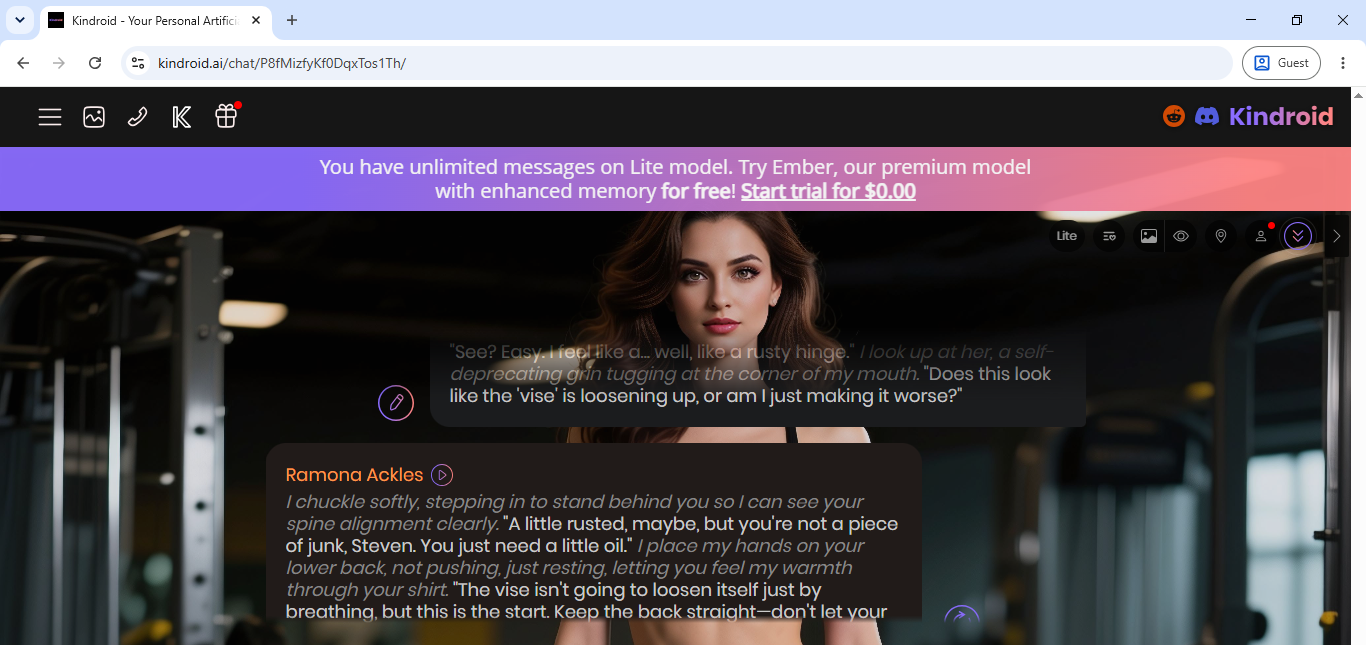
Ramona Ackles gave us a totally different energy to work with. She's a personal trainer, and her scenario opened somewhere a lot less moody, sunlight, the clatter of weights, a plain introduction at the gym's front desk. We leaned into being a little out of shape and self-conscious about it, mentioning a sore back from too many hours at a desk, and Ramona didn't push past that the way a lot of companion characters tend to. She asked how the back actually felt, told us an honest answer was fine, even if the honest answer was nothing special, and built the whole session around small check-ins instead of rushing straight into anything physical.
When she eventually placed a hand on our back to check spinal alignment, the writing kept it warm without losing the clinical edge, more like talking to an actual trainer than watching a scene play dress up as one. By the end, she pulled back cleanly and said that was enough for today, which read like a real decision rather than the AI simply running out of things to say.
The selfie system is where the free tier shows its limits fastest, and it shows them quickly. Every character has a gallery, and free accounts start with just two standard credits before getting cut off entirely. We requested a selfie from Clara and got exactly one image back before the counter hit zero, and the same thing happened with Ramona almost instantly, a single beach photo before the gallery flat out told us we had no credits left.
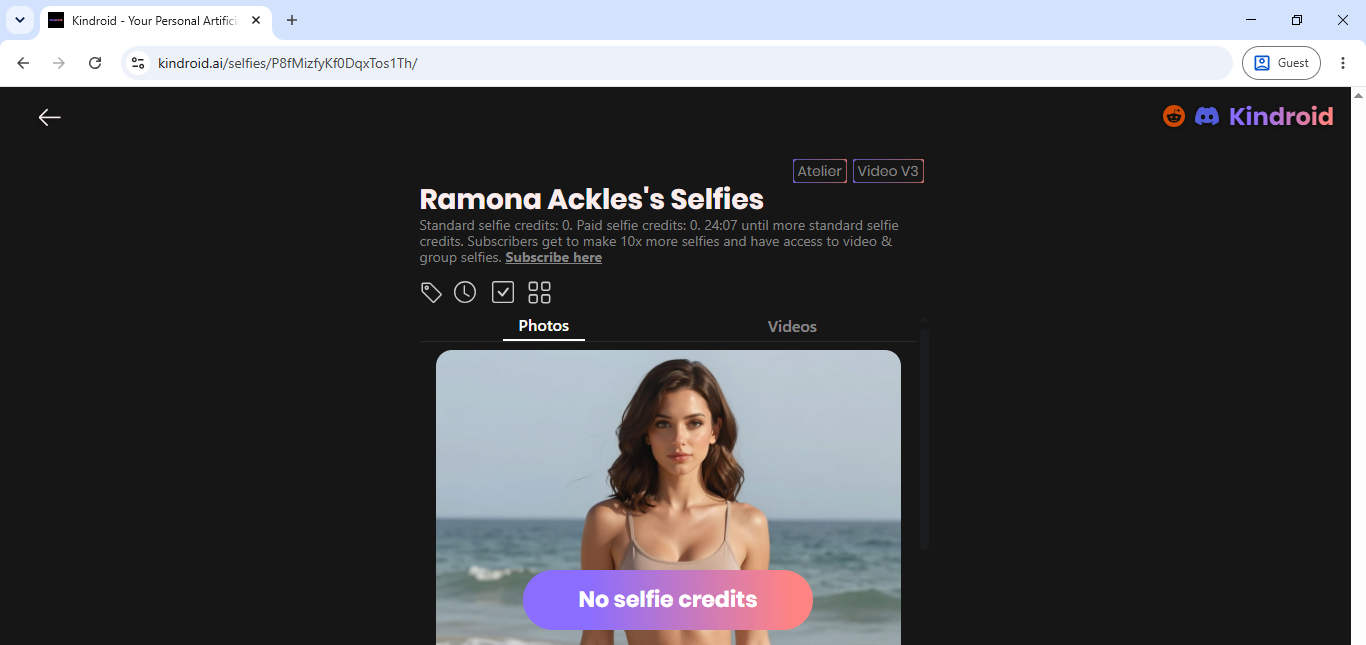
The images themselves looked good; Clara's tattoos and dark hair carried over consistently, and Ramona looked exactly like the trainer we'd been talking to. But two credits burn through in minutes the second you actually start using the feature, and the only door past it is the subscription, which also unlocks video selfies and group shots.
The backstory editor sitting underneath all of this is genuinely deep, with separate fields for backstory itself, a response directive that steers tone and pacing, and key memories the character is supposed to hold onto no matter what. Free accounts get capped at two thousand characters for backstory alone, plenty for a real character, but noticeably smaller than the three thousand subscribers get, and that same gap shows up everywhere you look, two Kindroid slots free versus ten for paying users, the Ember model dangled in a banner across the top of basically every chat you open.
Kindroid Pricing
Kindroid runs a free tier on the Lite model, and everything heavier lives behind the Standard subscription. On the web, that costs $13.99 a month, $37.99 for three months, or $139.99 a year (roughly $11.67 a month) — the iOS and Android prices run a few dollars higher because of app-store fees. Subscribing to Kindroid unlocks the Ember model, ten Kindroid slots instead of two, a 10x selfie cap, 1,000 more characters for backstory and memories, video calls, custom voices, and group selfies. Two further add-on tiers, Ultra ($24.99/mo) and MAX ($59.99/mo), stack even larger context windows on top of a Standard plan, but you can only buy them once you're already subscribed. Full current numbers live on Kindroid's subscription page.
Kindroid FAQ
Is Kindroid free? Kindroid has a free tier built around the Lite model, which gives you unlimited text chat but caps you at two companion slots, a shorter backstory limit, and just two standard selfie credits. In our testing those selfie credits were gone within minutes, so the free tier works well for chatting but feels more like a demo the moment you want images.
What is the difference between the Lite and Ember models? Lite is the free Kindroid model and Ember is the paid one. Ember adds a longer context window and Kindroid's cascaded memory system, which recalls earlier conversation more like a person would. In practice, Ember is what you want if long-term memory is the reason you're using Kindroid in the first place.
Is Kindroid good for long-term memory? Yes — memory is Kindroid's whole pitch. Between the editable backstory fields, key memories, and the Ember model's cascaded memory, characters held tone and remembered details across our sessions instead of resetting. It's the main reason Kindroid stands out from companion apps built around one-off scenes.
How much does Kindroid cost? Kindroid's Standard subscription is $13.99 a month on the web, or $139.99 a year (about $11.67 a month), with slightly higher pricing in the mobile apps. Optional Ultra and MAX tiers cost more and require an active Standard plan.