
DreamGen kept coming up in threads about uncensored AI role-play, the kind of place people mention when they say other platforms feel too restrictive for actual long-form story writing. So we went in and spent real time with it, running two scenarios that couldn't be more different from each other, testing the Scenario Wizard to build something from a single sentence, and poking around the separate image generator to see what it could actually produce. Here's what using DreamGen for an extended stretch is actually like once you're past the homepage and into the actual writing.
What Is DreamGen?
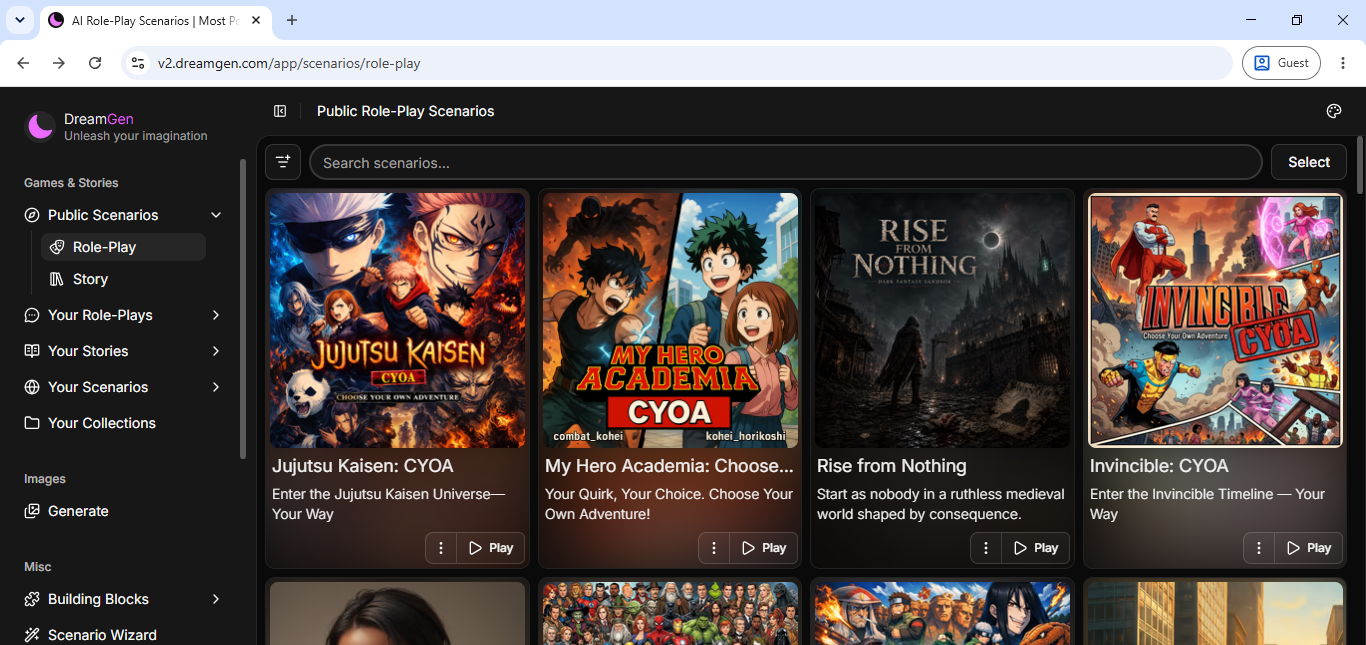
DreamGen is a text-based role-play platform built around full scenarios rather than simple character cards. Each scenario comes with its own plot, setting, and writing style guidelines baked in, so the AI isn't just playing a personality, it's running an actual story with rules about tense, tone, and pacing already set up before you type a single word. You can play public scenarios made by other users, build your own from scratch with full control over every field, or hand a one-line idea to the Scenario Wizard and let it flesh out the plot and setting for you in seconds. There's also a separate image generator that runs independently of the chat, useful for building reference art or visualizing a character rather than getting an automatic photo tied to every reply. A free tier gets you started, with more advanced models and higher output limits sitting behind a paywall. It sits in the same lane as the other roleplay AI chatbots we've tested.
The Review: Two Scenarios, One Wizard, and the Image Tool
We started with Class President with No Filter, a scenario built around Yara Voss, a sharp-tongued, no-nonsense class president character. The opening dropped us straight into a tutoring session, Yara already mid-insult about our handwriting before we'd even said anything back. We played Rick, a charming but disorganized pre-law student who struggles with math, and the contrast between the two personalities did a lot of the early work for us. We leaned into being a little defiant instead of apologetic, doodling in the margins of the worksheet, and she threatened to confiscate the paper and make us start over. What stood out was how much narration DreamGen layered in alongside the dialogue, actual descriptions of her posture straightening, her pen tapping against the desk, small physical beats that made the scene feel directed rather than a back-and-forth script. We pushed further by crowning a variable with a tiny doodle, which she caught instantly and used as an excuse to drop her guard for a second.
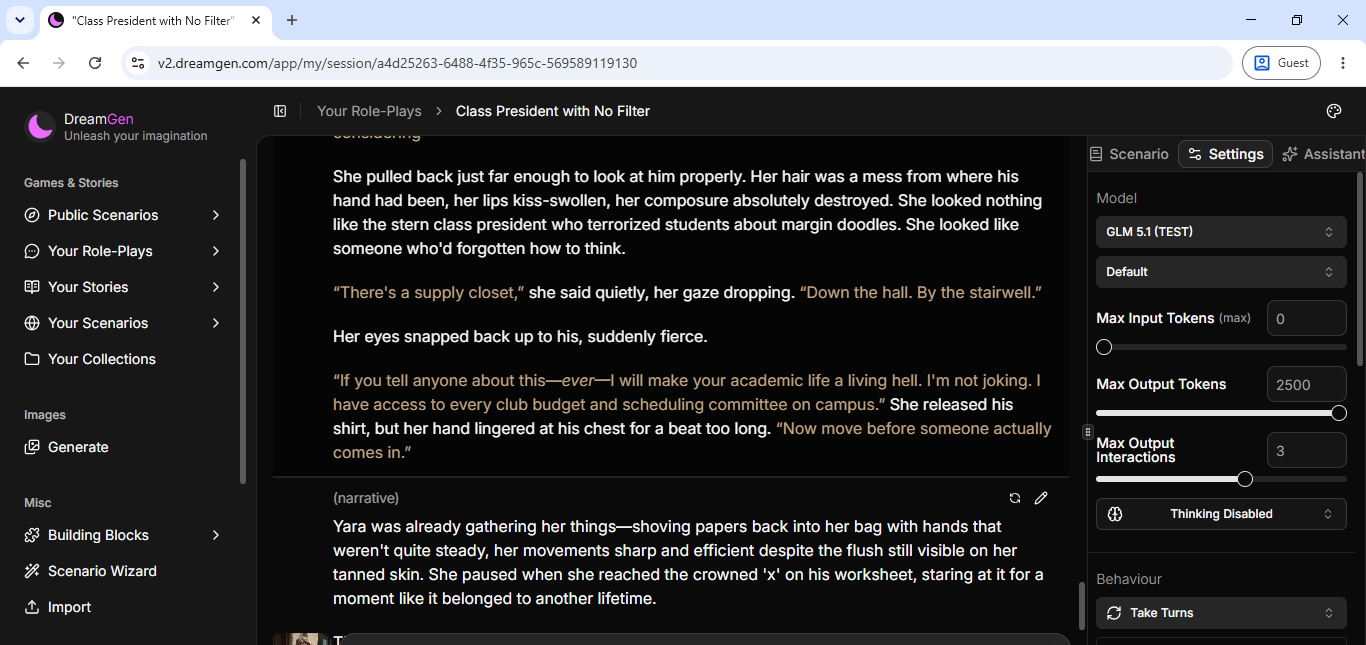
A kiss happened almost by accident in the middle of the lesson, and Yara's reaction wasn't a clean yes or a clean no; it was somewhere messier than that, her composure cracking while she kept insisting out loud that this was a mistake even as she pulled him closer instead of pushing him away. We followed her into the hallway and pushed things further, and the story didn't rush toward an easy resolution; it kept building toward a supply closet with the door barely shut, her threats about ruining his life sitting right next to her hand lingering on his chest a beat too long. The writing tracked that conflict well, giving her panic and her want equal weight instead of picking one and running with it.
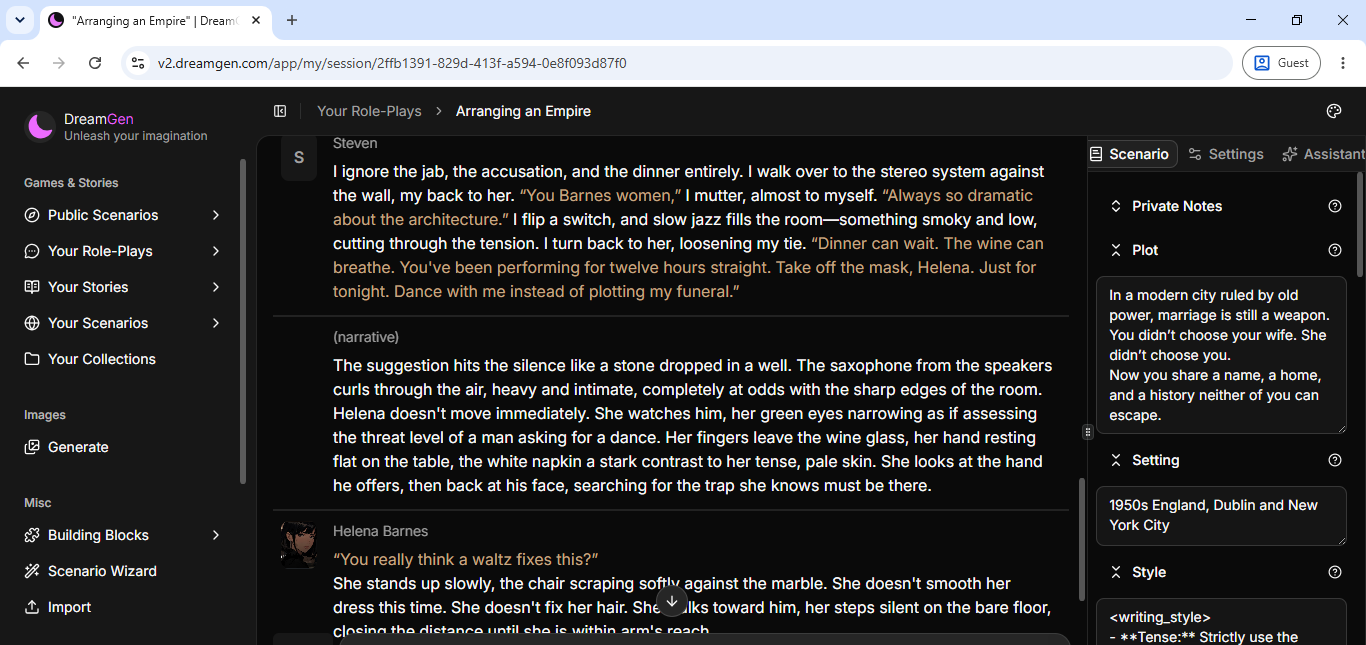
We swapped to something with a completely different rhythm for the second test, an arranged marriage scenario called Arranging an Empire set in the 1950s, built around a character named Helena Barnes. This scenario had a strict present-tense writing style enforced directly in its settings, and the difference showed immediately. The opening had the wedding already over, cameras gone, and Helena removing her heels the second the penthouse door closed, her public politeness dropping the instant nobody was watching anymore. We played Steven, her new husband, and instead of pushing for a confrontation right away, we tried something quieter, walking to the window and putting on music, inviting her to dance instead of arguing about a marriage neither of us chose. She didn't take the bait right away. She questioned the gesture out loud, suspicious of where it was leading, which felt true to a character who'd spent the whole evening performing composure for an audience and wasn't about to drop her guard for a stranger in a tuxedo. The slower pace worked in DreamGen's favor here; nothing got rushed into intimacy just because the setup technically allowed for it, the writing held back exactly as long as the characters themselves would have.
The Scenario Wizard turned out to be one of the more genuinely useful tools on the platform. We typed a single sentence, something about being kidnapped by a cult, only for its leader to decide to keep us rather than sacrifice us, and within seconds, it had built out a full plot summary and a named setting, complete with a cult name and a title for the antagonist. It's a fast way to go from a vague idea to something playable, and the manual scenario builder underneath it gives full control if you'd rather add characters, openings, and example dialogue by hand instead.
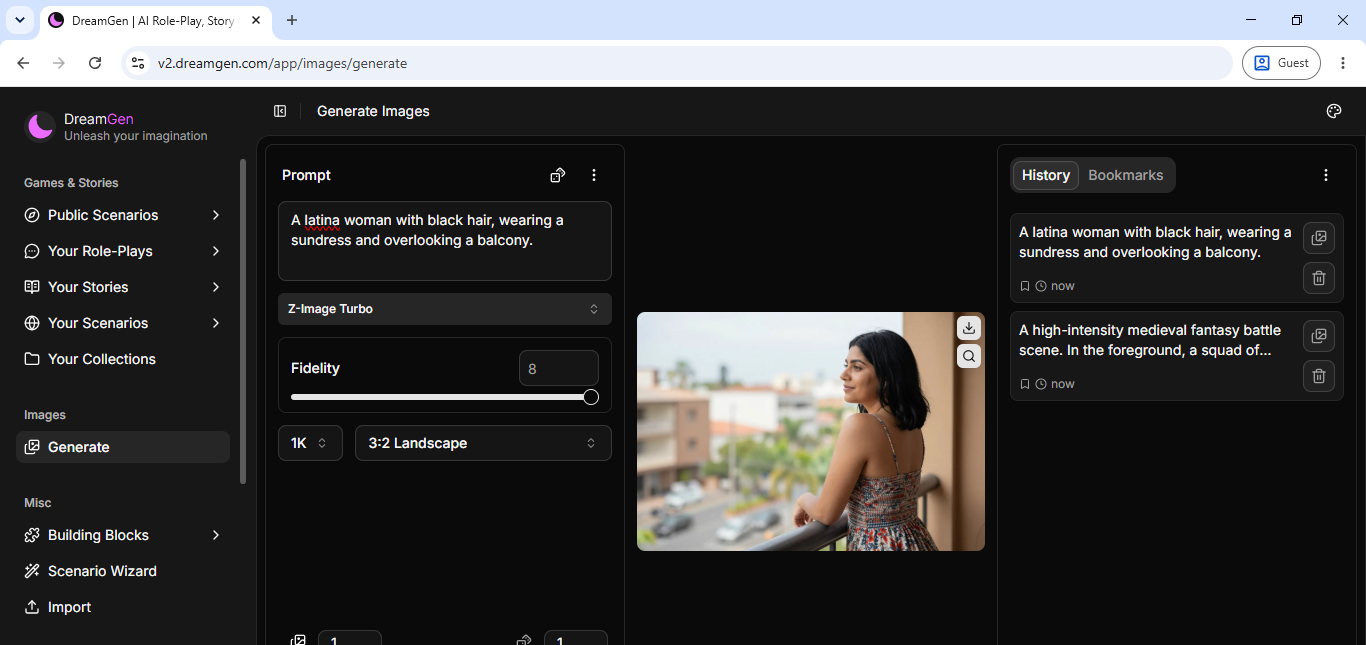
Image generation lives entirely separate from the chat, clearly built for reference art rather than anything reacting live to a conversation. We tried two very different prompts using the Z-Image Turbo model: a sprawling fantasy battle scene with a dragon and charging knights, and a simple portrait of a woman on a balcony, and both came back sharp and well composed, with no obvious confusion between the styles. It's a solid tool on its own terms, but it doesn't plug into the role-play scenes automatically the way some companion apps do, so don't expect a matching photo after every message.
DreamGen Pricing
DreamGen runs on a free tier plus three paid subscriptions, all built around a credit system rather than flat message caps. Starter comes in at roughly $7.83 a month and includes a 5,000-token context window, 375 monthly credits, 45 daily credits, and unlimited access to the basic and premium AI models. Advanced steps up to about $19.35 a month for a 15,000-token context window and 2,250 monthly credits. Pro sits at around $48.30 a month, widening the context window to 30,000 tokens and adding discounts on credit packs and select third-party models. DreamGen frequently runs promotional pricing, so the rate you see at signup is often 20–30% below those figures.
DreamGen FAQ
Is DreamGen free? Yes — DreamGen has a free tier that lets you play public scenarios and get a feel for the platform before paying anything. More advanced models, longer context windows, and higher daily output limits are what sit behind the paid plans.
Is DreamGen uncensored? In our testing, DreamGen handled mature, explicit scenarios without a filter cutting scenes short, and the pacing tracked what we actually wrote rather than rushing or refusing. For more options in this lane, see our NSFW AI chat roundup.
Does DreamGen generate images? Yes, but separately from the chat. The standalone image generator (running models like Z-Image Turbo) is built for reference art and character visualization, so it won't auto-attach a photo to every reply the way some companion apps do.
What makes DreamGen different? Scenario structure. Instead of opening a character card and going, you play or build a full scenario with its own plot, setting, and writing-style rules — including tense and tone — which is why DreamGen leans toward long-form, consistent storytelling over quick exchanges.