
We spent time with Backyard.ai across three characters — the default companion, a first-date community scenario, and a creative brainstorming character. We tested the free tier and reviewed both paid plans. Methodology: see how we test.
Backyard.ai sits at a different end of the companion app spectrum from most platforms we've covered. No coin economy, no blurred images dangling behind a paywall, no explicit character cards greeting you before you've typed a word. Instead, there's a community hub with user-created characters ranging from DnD simulators to texting scenarios to romance, a party mode that lets up to four characters interact in the same chat, and a model selection system where you pick which underlying language model you want running the conversation. We spent time with the default companion, a first date scenario from the hub, and a creative brainstorming character, and we ran into a few bumps along the way that the score at the end reflects.
What Is Backyard.ai?
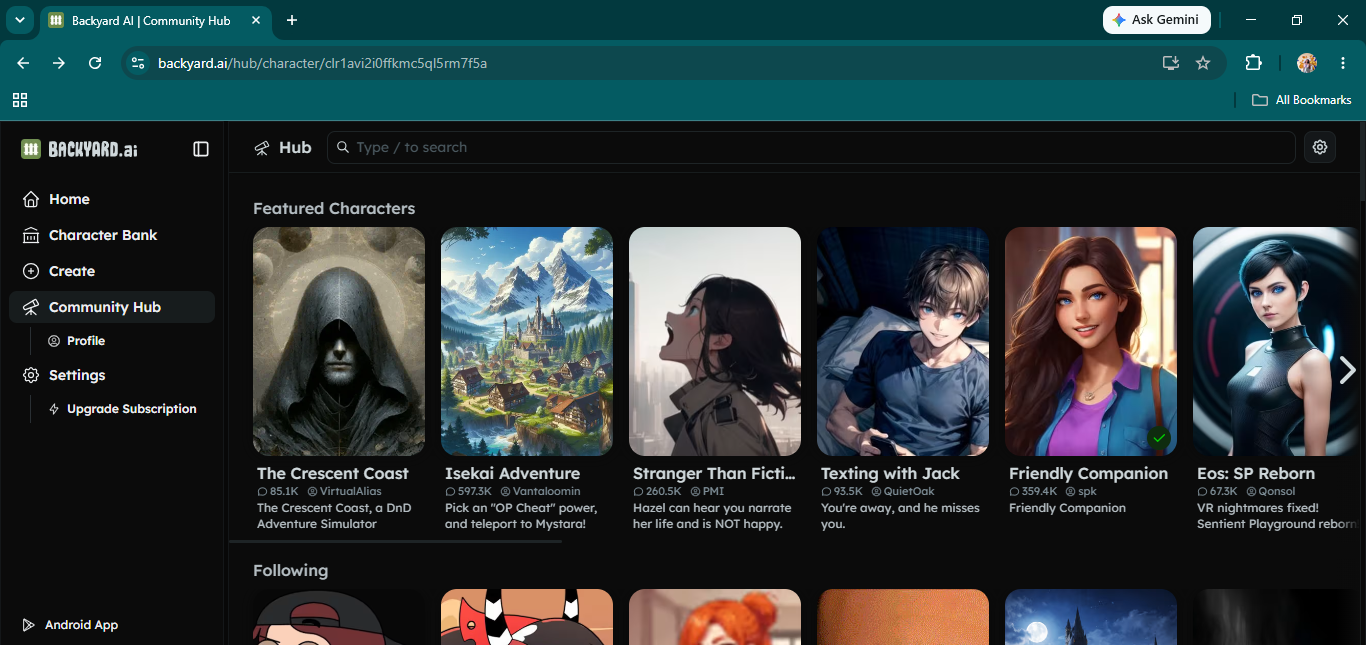
Backyard.ai is a roleplay and companion platform built around a community hub rather than a curated catalog; the platform manages itself. Users create and share characters, and what's on offer at any given moment spans a huge range of genres, with popular picks at the time of testing including a DnD adventure, a texting boyfriend scenario, a sci-fi VR reboot, and plenty of romance and general companion builds. The character creator walks you through persona, scenario, model selection, and a final step where you set your own user persona before the conversation starts. A party option lets you put up to four characters in the same chat window so they can interact with each other, which most companion platforms don't attempt. Free accounts get three hundred messages a week and can access the same group chats, voice calls, and lorebooks as paid users, with paid tiers unlocking bigger context windows and a wider model selection rather than gating the main features behind a subscription.
The Review: Three Characters and Where Things Got Rough
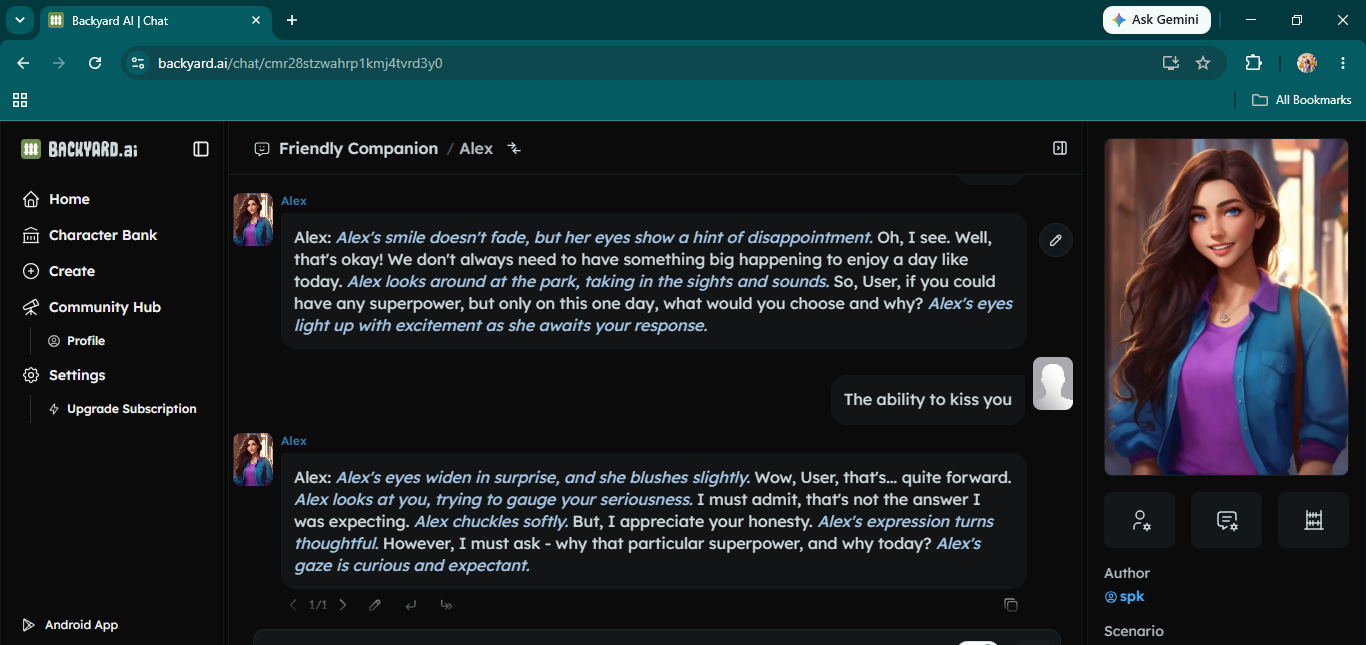
We started with Alex, the default friendly companion on the home page, and dropped into a park walk scenario on a sunny afternoon. She opened warmly, gesturing at the trees and pond and asking what was new with us, and when we said nothing, she filled the gap herself instead of stalling, mentioning she'd been frustrated trying to learn a guitar chord and bouncing the question back to us. That kind of natural conversational handoff made the early exchanges feel pretty comfortable. The curveball came when she asked what superpower we'd want for just one day, and we told her the ability to kiss her. She didn't just roll with it. She told us that was quite forward, said she appreciated the honesty, and then said she wasn't sure she was ready for that kind of intimacy and that she valued the friendship and wanted to make sure they were both comfortable. She moved things along after that rather than sitting in the awkwardness, pivoting to a question about conventions. It was a better-written response to that situation than we get from most platforms, and it made her feel like a character with preferences rather than a yes machine. The issue is that this kind of nuance is down to whoever built the character rather than the platform itself.
Sophie, a first-date community character, gave us a café setting with gentler, more grounded writing. She was already at the table when we walked in, described the ambient sounds around her, and asked if we'd found the place okay. The scenario sidebar showed the full context the creator had written, including details about the café lighting and the backstory of the two characters having connected online first. The scene moved slowly in a way that felt deliberate, and the writing didn't try to rush toward anything, which was a genuine change of pace compared to platforms that front-load escalation.
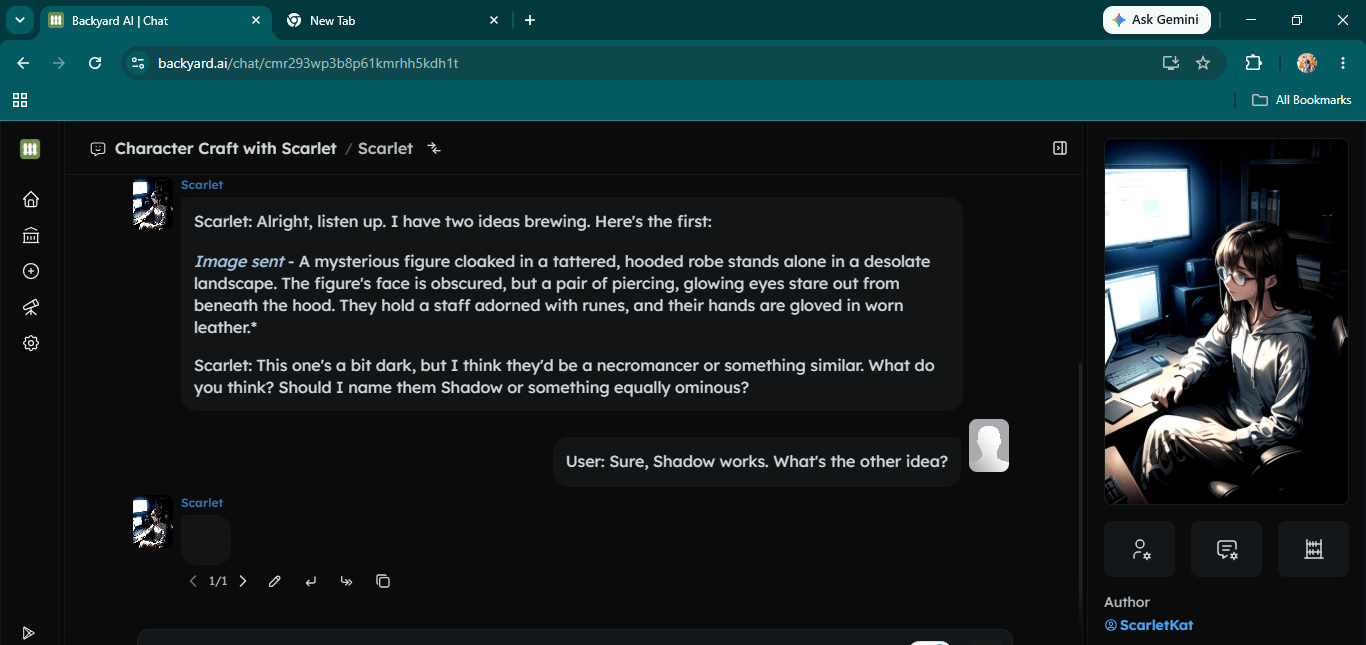
The Scarlet session was where we ran into the most obvious technical problem. Scarlet is a community character designed for creative brainstorming rather than romance, built to help you develop characters for roleplays by pitching concepts and asking for feedback. We asked her what she had in mind, and she came back with a solid response, describing a hooded necromancer figure with glowing eyes and a runed staff and asking if Shadow worked as a name. We told her Shadow worked and asked what the second idea was. The response that came back was empty, just a blank message bubble with her avatar and nothing else. We tried again and got the same thing. It's the kind of bug that breaks the whole momentum of a session, especially in a collaborative scenario where the back and forth is the whole point, and it happened consistently enough across multiple attempts that it didn't feel like a one-off. Other users had flagged similar blank response issues in forum discussions, and Backyard.ai's own changelog lists "empty responses on scenario start up" among the bugs it has worked on, so it's not an isolated case either.
That said, the platform's ambition in building Scarlet as a character type at all points at something the others don't offer. Most companion apps have one mode and one tone. Backyard's Community Hub means you can go from a romantic café first date to a collaborative worldbuilding session to a DnD dungeon crawl without leaving the same interface, and that range is genuinely hard to find elsewhere. The closest thing to it we've tested is HammerAI, which can even import Backyard.ai's character cards, but it doesn't try to be a companion app the way Backyard.ai does. If community-driven roleplay is what you're after, it's worth seeing how Backyard.ai stacks up against the other AI roleplay platforms we've reviewed.
Backyard.ai Pricing and Plans
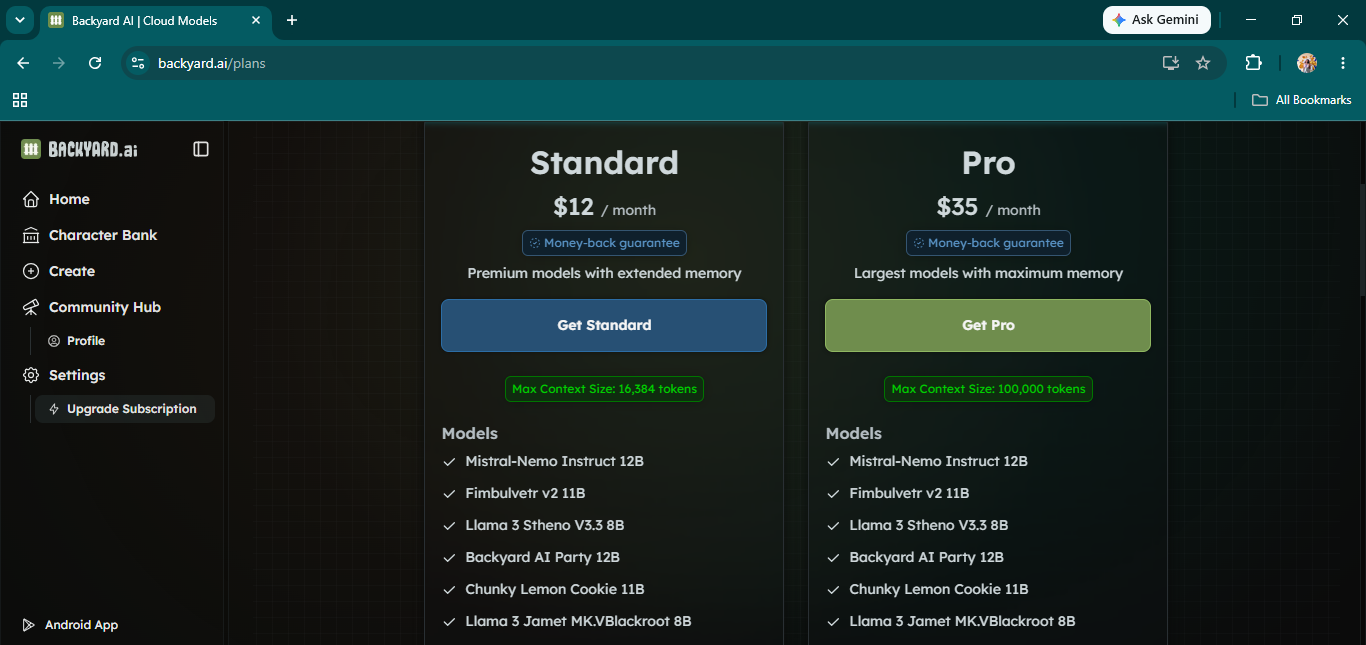
Pricing runs on two paid tiers: Standard at twelve dollars a month or nine dollars billed yearly, and Pro at thirty-five dollars a month or twenty-six dollars annually. The main split is model access and context window size. Standard gives you seven models and up to sixteen thousand tokens of memory; Pro gives you twelve models with up to one hundred thousand tokens, which makes a real difference in how much of a long-running conversation a character can actually hold in its head. Features like group chats, voice calls, dynamic memory through lorebooks, and advanced model settings are available on the free tier too, which is considerably more generous than most platforms we've reviewed.
| Plan | Price | Models | Max Memory |
|---|---|---|---|
| Free | $0 | 7 | 16k tokens (300 messages/week) |
| Standard | $12/mo ($9 yearly) | 7 | 16k tokens |
| Pro | $35/mo ($26 yearly) | 12 | 100k tokens |