Open Instagram, and the pattern becomes hard to miss. The most-followed virtual influencers — the ones landing deals with Netflix, Adidas, Hugo Boss, and Prada — are almost all female-presenting. Lu do Magalu, Lil Miquela, Aitana López, Noonoouri, Imma, Shudu Gram. The trend holds from Brazil to Spain to Japan to Germany. These women AI influencer statistics tell a story about who is being built to front modern marketing, what the money actually looks like behind the CGI, and who profits from it.
For the full market-size and engagement breakdown across all virtual creators, see our AI influencer statistics report. This piece zooms in on the women.
The short version
- The most-followed virtual influencers in the world are all female-presenting — the top five range from 8M to ~390K followers.
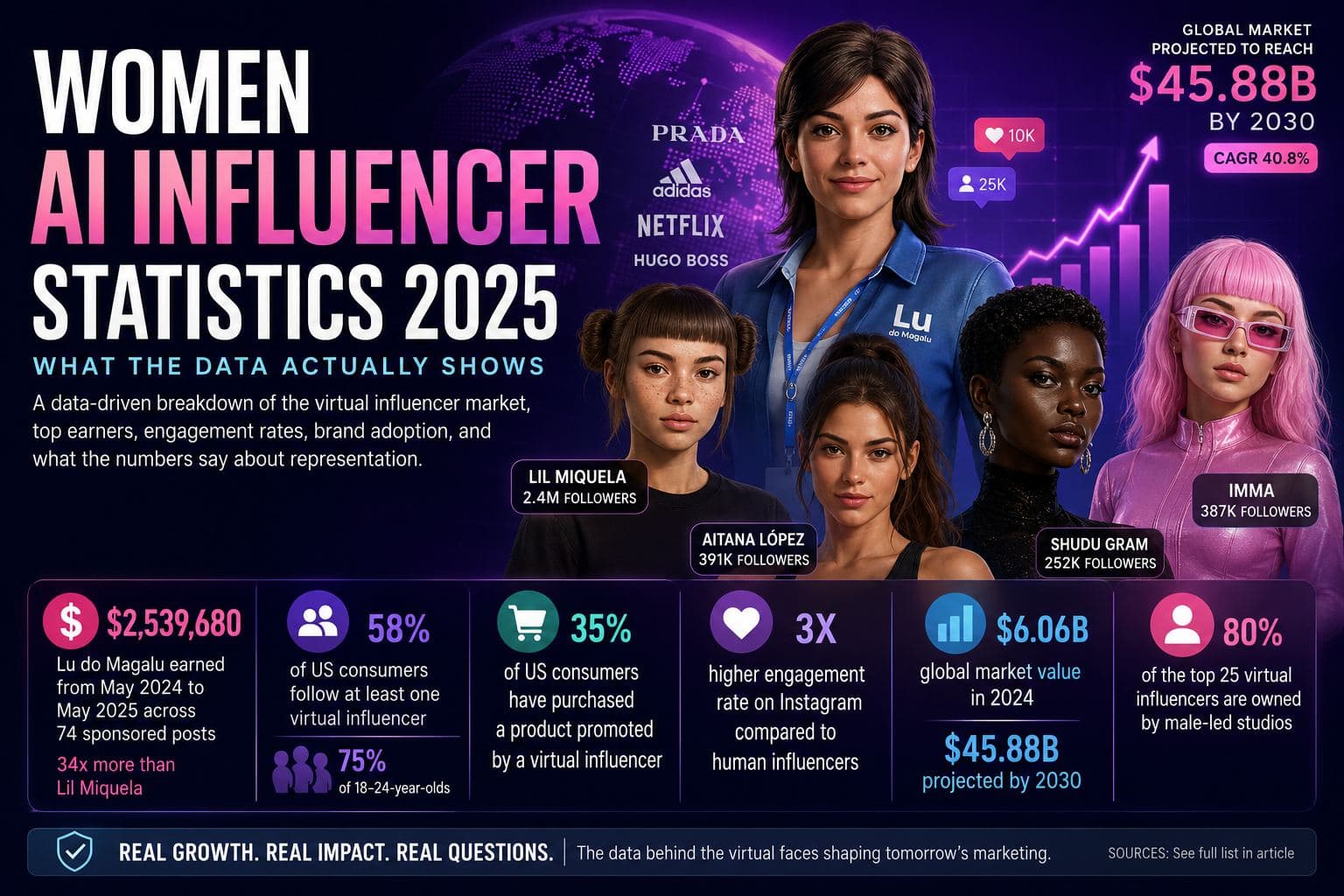
- Lu do Magalu earned an estimated $2,539,680 (May 2024–May 2025), 34× more than the next-highest earner, Lil Miquela.
- Female-presenting "human avatar" personas account for 68% of total market revenue.
- An estimated 80% of the top 25 virtual influencers are owned by male-led studios.
- Women creators earn roughly $0.77 for every $1 male creators make on comparable deals.
What Is a Women AI Influencer?
A woman AI influencer is a female-presenting virtual persona created entirely through CGI, artificial intelligence, or a combination of both. She is not a real person. She exists only in digital form but operates like a human creator: posting content, building an audience, and signing brand deals. This is different from AI-assisted human creators, who are real people using AI tools to improve or speed up their content. The distinction matters both for disclosure laws now in effect and for the ongoing conversation about who controls these personas and what they represent.
The Most-Followed Virtual Influencers Are All Women
Sort the global leaderboard by follower count and the top tier is entirely female-presenting:
- Lu do Magalu — 8M Instagram followers
- Barbie — 3.5M
- Lil Miquela — 2.4M
- Aitana López — 391K
- Imma — 387K
(Followers per Kapwing, July 2025, and Instagram / @fit_aitana, June 2026.) Female-presenting "human avatar" personas like Lu and Aitana account for over 68% of total virtual-influencer market revenue (Grand View Research, 2024) — the female face isn't a stylistic preference, it's where the money is.
What They Earn — and the Gap Between Them
Lu do Magalu is the highest-earning virtual influencer in the world, making an estimated $2,539,680 from May 2024 to May 2025 across 74 sponsored posts — roughly $34,320 per post, and about 40 times the average human influencer's annual income of $65,245 (Inc., July 2025).
The gap between her and everyone else is the real story. Lil Miquela earned an estimated $73,920 in Instagram-specific sponsored posts over the same 12 months — 34 times less than Lu — despite comparable follower counts to other top personas. Aitana López earns up to €10,000 per month through brand partnerships, with the average month closer to €3,000 (Euronews, December 2024).
| Influencer | Instagram followers | Earnings |
|---|---|---|
| Lu do Magalu | 8M | $2,539,680 (May 2024–May 2025, 74 posts) |
| Barbie | 3.5M | ~$15,400 per sponsored post |
| Lil Miquela | 2.4M | $73,920 (Instagram sponsored posts, same period) |
| Aitana López | 391K | Up to €10K/month |
| Imma | 387K | $600K+ per year (industry estimate) |
Sources: Kapwing, Euronews, and Argil AI (Imma estimate).
Who Owns the Women
The personas are female. The owners, mostly, are not. Among the top 25 virtual influencers by follower count, an estimated 80% are owned or operated by male-led studios — a figure consistent with our broader AI influencer analysis. The same gap shows up among the human creators behind the industry: women earn roughly $0.77 per $1 that men earn for comparable sponsorship deals, and 68% of women creators use AI tools regularly versus 79% of men — an 11-point gap.
So the most visible faces of the AI creator economy are women, while ownership, control, and the larger paychecks skew male.
How They're Built to Look
When Aitana López's creator was asked about her sexualized appearance, he was blunt: "If we don't follow this aesthetic, brands won't be interested. To change this system, you have to change the vision of the brands." (Euronews, December 2024.) Critics argue AI influencers "perpetuate a highly sexualised image in marketing," and that digitally perfected appearances risk driving negative self-comparison among young girls (Entrepreneur).
Representation gets thornier. Shudu Gram, presented as a Black woman and created by a white male photographer, was described by some as digital blackface and by others as pioneering Black representation in fashion (Argil AI, 2024). The debate hasn't resolved — and it's a debate about a woman who doesn't exist, designed by someone who doesn't share her presented identity.
Who's Actually Watching
The audience for these female personas skews young and female. Women aged 18 to 34 make up 44.76% of virtual-influencer followers on Instagram — double the proportion on regular influencer accounts — and 14.64% of followers are aged 13 to 17, again about double the ~7% for human creators (HypeAuditor, 2021). On engagement, virtual influencers run nearly 3× the rate of human creators on Instagram.
That young audience often can't tell the difference: a 2025 Stanford Media Futures Lab study found 68% of teen respondents could not distinguish AI-generated influencers from real people (CreatorFlow, February 2026).
Buying behavior is more skeptical. 35% of US consumers have purchased something promoted by a virtual influencer, but 65% say they are unlikely to — and intent drops sharply with age: 40% of 18-to-34-year-olds have bought something a virtual influencer promoted, versus just 18% of those 55 and over (ION / Influencer Marketing Factory, March 2022, n=1,044). More than half of US consumers — 58% — follow at least one virtual influencer; among 18-to-24-year-olds, that rises to 75% (Influencer Marketing Factory, March 2022; Statista, March 2022).
Fronting the Ads: Disclosure and the Law
Because these women front paid campaigns, regulation now reaches them directly. Under the updated FTC framework, virtual influencer content requires disclosure of both the commercial relationship and the AI origin — clearly, and where the audience will see it (The Social Media Law Firm, 2026). Civil penalties reach up to $51,744 per violation, with each non-compliant post counting separately.
The rules are still arriving. New York's law requiring disclosure of synthetic performers in advertising took effect June 9, 2026, and the EU AI Act's disclosure requirements for AI-generated content took effect August 2, 2026 (Dynamis LLP, 2026). Meanwhile the operations behind these personas keep scaling: Aitana López now has an eleven-person team managing her content while her creator builds additional AI personas (Fast Company, May 2026).
The Bottom Line
The virtual influencer economy is built almost entirely around female-presenting personas operated by commercial agencies — and the further you get from the camera, the more the money and control skew male. The faces are women; the owners often aren't. The audience is disproportionately young women and teenage girls, many of whom can't tell these personas from real people. And the earnings gap between Lu do Magalu and everyone else is a reminder that even among synthetic women, a tiny few capture almost all the value.
The CGI keeps getting better. The questions about who's behind it — and who it's aimed at — aren't going anywhere.