We've spent the last year tracking how AI is reshaping the way people connect — and the same generative tech now powers a different kind of "person" entirely: the virtual influencer. So we pulled the 2026 numbers on AI and virtual creators to see how big this corner of the economy has actually gotten. No fluff, just data — every figure sourced.
The short version
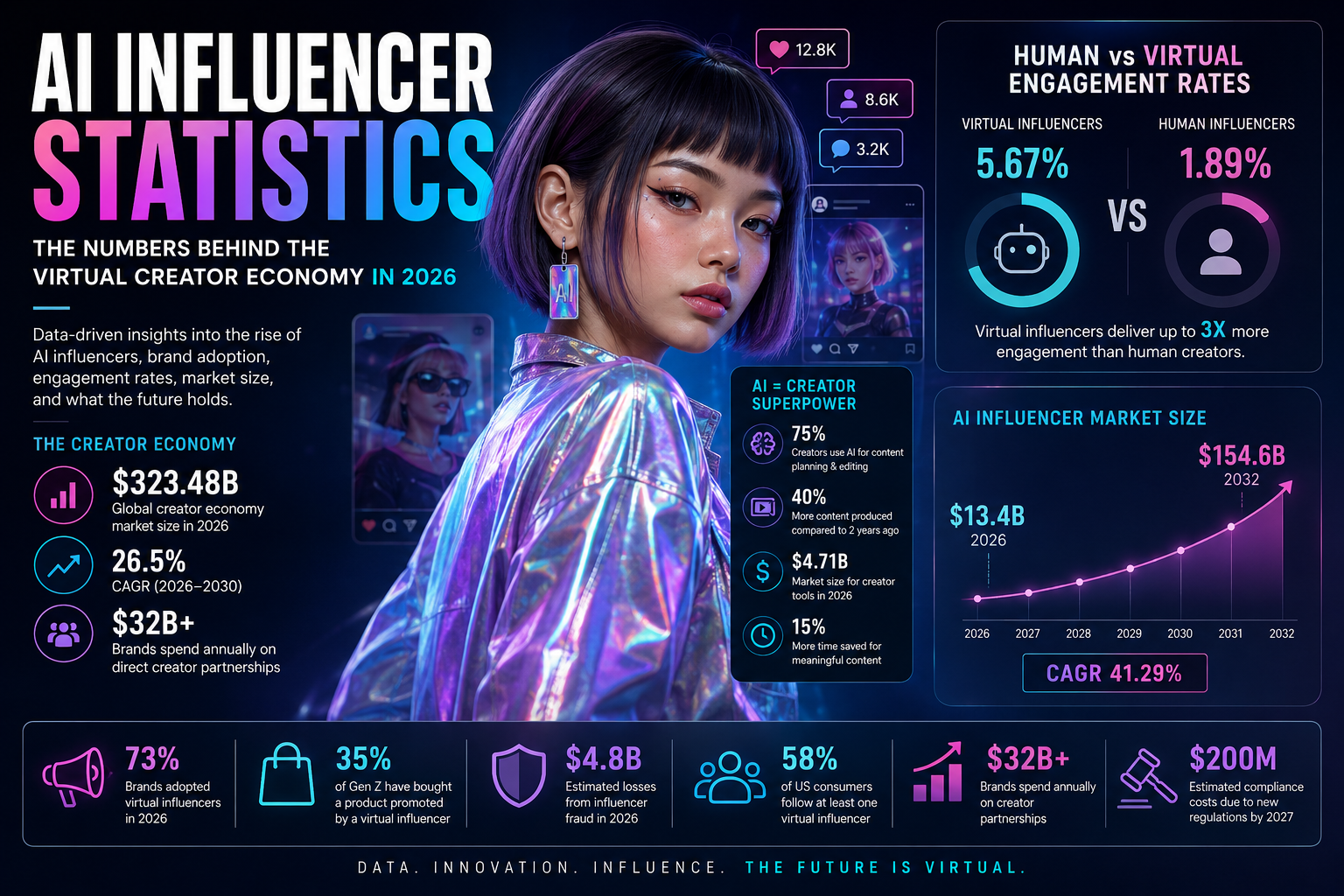
- The virtual influencer market hit $11.74B in 2026, on track for $154.6B by 2032 (41.29% CAGR).
- Virtual influencer campaigns average a 5.67% engagement rate versus 1.89% for human creators — roughly 3× higher.
- Lu do Magalu earned about $2.5M in 2024 across 74 brand collaborations — around $34,320 a post.
- An estimated $4.8B was lost to influencer fraud in 2026, and regulators are circling.
The Market at a Glance
The creator economy has graduated from hobby to industry, fundamentally restructuring how media gets made and monetized. Individual content creators are now the largest segment of the market, overtaking traditional media houses in total revenue share — proof that one person can now manage the output and revenue that once required a whole company. Brands spend upwards of $32 billion annually on direct creator partnerships, and that spending is increasingly performance-based rather than awareness-based.
Here's how the headline market figures break down. Note that "AI influencer" and "virtual influencer" come from different report definitions, so we list both rather than blend them:
| Market definition | 2026 size | Forecast |
|---|---|---|
| AI influencer market (broad) | $13.4B | $62.67B by 2030 (40.9% CAGR) |
| Virtual influencer market | $11.74B | $154.6B by 2032 (41.29% CAGR) |
| Creator-tool market | $4.71B | — |
| Global creator economy | $323.48B | $820.83B by 2030 |
Sources: SNS Insider (virtual influencer market), Coherent Market Insights (creator economy), and SQ Magazine (AI influencer and creator-tool markets).
What AI Did to the Creator Economy
AI isn't replacing creators — far from it. It acts as an "operations layer," letting individuals refine their work to premium-studio standards and produce higher-quality output faster, turning a one-person show into a full-scale media operation.
- 75% of professional creators used AI tools for content planning, scriptwriting, and video editing as of 2026, helping them produce 40% more content than they did two years ago. (The same adoption curve is playing out across customer-facing tools, too — see our AI chatbot statistics.)
- 46% of creators now use AI for audience behavior analysis and growth insights, taking the guesswork out of what to publish next.
- AI now handles administrative tasks for 34% of creators — community support, email, and moderation — freeing up about 15% more of their time for meaningful work.
- AI-generated characters and virtual influencers are leading the trend, letting people create content without being on camera. (We've tracked the same generative shift on the companionship side in our AI girlfriend statistics breakdown.)
- Chief Marketing Officers are allocating up to 30% of their influencer marketing budgets to virtual influencers.
- China spent $1.6 billion in the virtual influencer space, home to 340 million active virtual influencer followers.
The Women Creators AI Monetization Gap
Women make up the majority of content creators on Instagram and TikTok but earn meaningfully less per sponsored post than men — a gap that AI tools have not yet closed.
- Women creators earn roughly $0.77 per $1 that male creators earn for comparable sponsorship deals, per NeoReach's 2025 Influencer Marketing Report.
- 68% of women creators use AI tools regularly vs 79% of men, an 11-point adoption gap that compounds the earnings gap.
- Among the top 25 virtual influencers by follower count, an estimated 80% are owned or operated by male-led studios — the upside of the AI virtual-creator boom is accruing disproportionately to male founders, not female creators.
- 31% of women creators cite "lack of time to learn new tools" as their top barrier to AI adoption (vs 19% of men).
Highest-Earning AI Influencers in 2026
A handful of names own most of the global virtual influencer revenue. Lu do Magalu still leads the field, but a second wave of named AI personas now pull six-figure annual brand budgets.
Lu do Magalu earned about $2.5M in 2024 across 74 brand collaborations — roughly $34,320 a post, or about 40× a human influencer, according to Inc.
| Influencer | Earnings | Followers | Notable brands |
|---|---|---|---|
| Lu do Magalu | ~$2.5M (2024, 74 collabs) | 8M IG · 7.4M TikTok | Magalu |
| Lil Miquela | ~$11M career brand-deal revenue | 2.4M IG | Calvin Klein, Prada, Samsung |
| Imma | Est. low six figures/month | 3M IG | IKEA, Coach, Calvin Klein |
| Noonoouri | Undisclosed, signed to Warner Music 2023 | 480K IG | Dior, Versace, Valentino |
| Shudu | Est. mid five figures/post | 240K IG | Balmain, Fenty Beauty |
| Aitana López | Five figures/month | 380K IG | Big |
Human vs Virtual Influencer Engagement Rates
From a brand-marketing perspective, virtual influencers routinely beat humans on impressions-to-interaction ratios.
Virtual influencer campaigns average a 5.67% engagement rate versus 1.89% for human creators — about 3× higher, per HypeAuditor.
| Metric | Virtual | Human |
|---|---|---|
| Average campaign engagement | 5.67% | 1.89% |
| High-end (by platform/category) | 5.9% | 1.9% |
| Instagram brand campaigns | +30% vs brand average | — |
| Authenticity-driven categories | — | up to 2.7× higher |
One caveat worth keeping in mind: in categories where authenticity matters most, sponsored posts by human creators can outperform virtual ones by up to 2.7×. Prada's collaboration with Lil Miquela, by contrast, generated 30% higher engagement than the brand's average campaign.
Brand Adoption of Virtual Influencers
Virtual influencers are no longer an experiment — most major consumer categories now run at least one virtual creator program.
| Industry | Brand adoption |
|---|---|
| Beauty & personal care | 89% |
| Fashion | 78% |
| Gaming | 76% |
| Consumer electronics | 64% |
| Luxury | 58% |
| Financial services | 22% |
- Brand adoption of virtual influencers rose from 60% to 73% of all surveyed companies worldwide as of 2026, per Influencer Marketing Hub.
- About 47% of brands raised their influencer marketing budgets by 11% or more, and 80% of brands either maintained or increased their budgets in 2025.
- More than 66% of marketers believe AI adoption has improved their overall campaign outcomes.
- Adoption of AI influencers among top Fortune 500 marketers ran at 3.4× the 2023 rate in 2026.
Is the AI Influencer Market Saturated in 2026?
Short answer: saturated at the top, wide open in the middle.
The top tier looks crowded. The number of virtual influencers with 1M+ followers has grown from roughly 150 in 2023 to over 400 in 2026, and engagement rates on the largest accounts have slipped from 5.9% in 2023 to 5.67% today — small but directional.
The middle and niche tiers tell the opposite story. Virtual micro-influencers (10K–100K followers) are the fastest-growing cohort, brand adoption is still climbing (60% → 73% of surveyed brands in two years), and only 22% of financial-services brands have run a virtual-creator campaign — leaving large verticals barely touched. CMO budget share for virtual creators is forecast to hit 40–45% by 2030, well above current allocations.
Saturation is a real concern for new mega-personas chasing Lu do Magalu numbers. It's not a concern for niche virtual creators in under-served categories.
AI Usage by Influencer Marketing Workflow Phase
The data reveals that brands trust AI to find creators, not to verify them. Everything slows down once an audit trail is involved — teams take their time scanning an AI-discovered influencer's follower list for fakes. Brands are comfortable letting AI handle the fast, low-stakes tasks, but pump the brakes the moment legal and financial matters enter the picture. That's where a "validation gap" opens: human trust ends where AI validation begins.
| Workflow stage | Marketers using AI |
|---|---|
| Any use in influencer programs | 89.44% |
| Creator discovery | 36.67% |
| Content generation | 21.11% |
| Brief development | 13.89% |
| Reporting trails | 10.56% |
| Fraud detection | 7.22% |
AI is handy for scanning millions of profiles, but signing a fraudulent influencer carries real reputational and legal risk — so teams still lean on human auditors for verification. Gen Z, meanwhile, follows virtual influencers at high rates but doesn't trust them as much, a gap brand teams have to work around rather than dismiss.
Audience Demographics & Consumer Behavior
Older demographics remain skeptical, but Gen Z embraces virtual influencers with high follow rates and meaningful purchase conversions.
- About 35% of Gen Z report buying a product promoted by a virtual personality.
- 75% of Gen Z followers engage with virtual influencer profiles.
- 15% of one survey's respondents rated their trust in virtual-influencer-promoted products a 7 out of 10.
- 50% of brand managers who collaborated with virtual influencers called the experience very positive.
- Still, 43.8% of consumers report ethical concerns with AI influencer use.
- About 58% of US consumers follow at least one virtual influencer, per HypeAuditor.
Recent Developments
- 10.56% of marketers said they did not use AI in their influencer programs at all (Influencer Marketing Hub).
- The beauty industry leads the virtual creator economy with 89% brand adoption (Wearisma, Beauty Influencer Marketing Benchmarks).
- Micro and nano influencers will command 45.5% of total influencer marketing spend, per eMarketer's Creator Economy 2026 forecast.
Some Rotten Apples in the AI Virtual Influencer Market
An estimated $4.8B was lost to influencer fraud in 2026, and 2,340 creators are under FTC and UK FCA investigation for fake or AI-generated reviews under the FTC's October 2024 rule.
- The $4.8B figure comes from Sumsub's AI Deepfakes and Creator Economy Fraud Detection Guide.
- Across all sectors — not just influencers — deepfake-enabled fraud caused an estimated $23.7 billion in losses globally.
- 74% of deepfake scams are run with AI tools that cost as little as $50 per campaign.
- Influencer-promoted scams are rising 47% year over year.
The Future of AI in Influencer Marketing
Two scenarios could unfold by 2030: aggressive growth as generative tools keep improving, or tighter regulation as deepfake scams mount.
| Metric | Forecast | By |
|---|---|---|
| AI influencer market | $62.67B (40.9% CAGR) | 2030 |
| Virtual influencer market (high-end) | $154.6B (41.29% CAGR) | 2032 |
| CMO budget to virtual influencers | 40–45% | — |
| AI fraud losses | $5B | 2028 |
| Brand–influencer collabs integrating AI daily | 80% | 2028 |
| Virtual influencers with 1M+ followers | 600+ (from ~150 today) | 2030 |
| Industry-wide compliance costs | +$200M | 2027 |
The EU AI Act, FTC Endorsement Guides, and UK FCA frameworks are the main drivers of that compliance bill.
Conclusion
Marketing teams that put AI to work on creator discovery and content generation are now outperforming those still doing everything by hand. But the $4.8 billion lost to influencer fraud in 2026 — plus the compliance costs piling up as regulators move in — is a reminder that this game has real downside alongside the revenue. The brands that come out ahead will be the ones that pair AI's speed with human auditing of AI-discovered influencers, disciplined disclosure, and clear AI-creator licensing terms.