
A research-based breakdown of teen dating patterns, digital behaviors, relationship health, and outcomes — for parents, educators, and policymakers. That digital behavior increasingly includes AI companions, too — our AI companion statistics found 72% of US teens have tried one.
Key Stats at a Glance
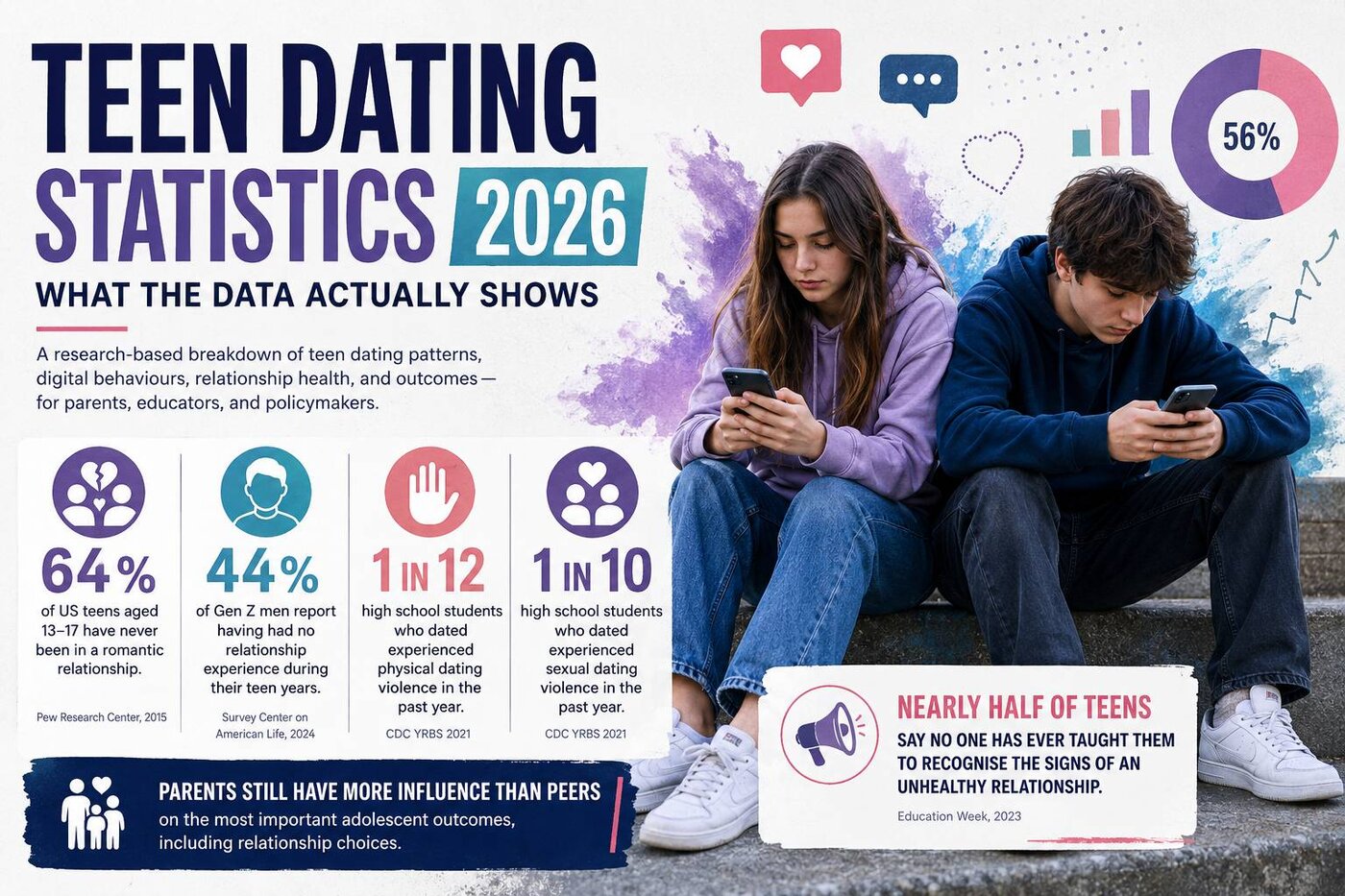
- Only 56% of Gen Z adults say they were ever in a romantic relationship as a teenager, compared to 78% of Baby Boomers and 76% of Gen Xers at the same age.
- 44% of Gen Z men report having had no relationship experience at all during their teen years — double the rate for older generations of men.
- Among US teens aged 13 to 17, 64% have never been in a romantic relationship of any kind.
- Among high school students who dated, 1 in 12 experienced physical dating violence and 1 in 10 experienced sexual dating violence in the past year.
- LGB students are more than twice as likely as heterosexual students to experience sexual dating violence.
- Parents still have more influence than peers on the most important adolescent outcomes, including relationship choices. Yet most teens say no one has ever explicitly taught them to recognize the signs of an unhealthy relationship.
Most adults assume teens today are diving into relationships earlier and faster than any generation before. The data says the opposite. Teenagers in the US are dating less than their parents did, less than their grandparents did, and the gap keeps widening. This article pulls together verified research on when teen dating starts, how digital tools have changed it, where the real risks sit, and what actually moves the needle. Every figure is tied to its source. Statistics without an age range or a sample context have been left out.
When Teen Dating Actually Starts
"Teen dating" gets treated as one thing when it actually describes three separate milestones that researchers track individually: first romantic interest, first relationship, and first date. Collapsing them produces numbers that are hard to use.
Romantic interest tends to show up between ages 10 and 13, well before most teens enter an actual relationship. First relationships come later, shaped by peer norms, individual development, and social context. The data for US teens aged 13 to 17 looks like this:
- 64% of teens aged 13 to 17 have never been in a romantic relationship of any kind (Pew Research Center, n=1,060, US, 2015)
- Only 35% of teens in that age range have any relationship experience at all, whether current or past (Pew Research Center)
- Of those 35%, 14% are currently in a relationship they consider serious, 5% are in a non-serious current relationship, and 16% have had a past relationship only (Pew Research Center)
- Teens aged 15 to 17 are roughly twice as likely to have had any relationship experience as those aged 13 to 14 — 44% vs around 20% (Pew Research Center)
- Among teen daters, 30% have had sex, but two-thirds of teens with relationship experience say they have not (Pew Research Center)
The generational decline is the bigger story:
- 56% of Gen Z adults say they were in a romantic relationship at some point during their teen years (Survey Center on American Life, 2024)
- That compares to 78% of Baby Boomers and 76% of Gen Xers who say the same (Survey Center on American Life)
- 69% of Millennials also report having had a boyfriend or girlfriend as a teenager — still well above Gen Z (Survey Center on American Life)
- 44% of Gen Z men report having had no relationship experience during their teen years, compared to 23% of Gen X men and 20% of Baby Boomer men (Survey Center on American Life)
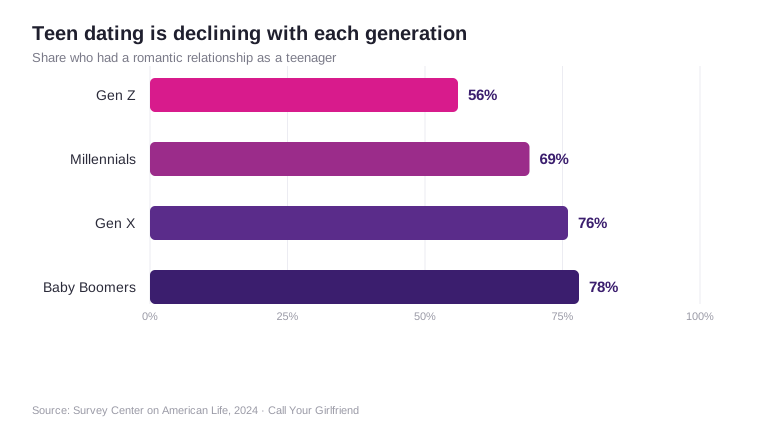
The reasons researchers point to: rising academic pressure, pandemic-era disruption to social development, a cultural shift away from treating early relationships as a rite of passage, and the replacement of in-person socializing with digital interaction — and it is the same cohort that now reports being the loneliest generation on record.
How Teens Date Now vs Ten Years Ago
Digital platforms did not replace in-person teen relationships. Most still start face-to-face. What changed is everything that happens after that.
- Only 8% of teens aged 13 to 17 say they have met a romantic partner online (Pew Research Center, US, 2015)
- Among teens who have some relationship experience, 24% have dated or hooked up with someone they first met online (Pew Research Center)
- Of those who met a partner online, 69% eventually met that person in person, and 31% never did (Pew Research Center)
- Texting is by far the most common way teen daters interact daily — 72% of teen daters text their partner every day; talking by phone ranks second at 39% (Pew Research Center)
- Social media is the most common way teens signal interest in someone they like, outside of flirting in person (Pew Research Center)
- 27% of teen daters say social media makes them feel jealous or uncertain about their relationship (Pew Research Center)
- Dating app use among early adolescents is rare: only 0.4% of young teens (mean age 12, n=9,732) report ever using one (BMC Research Notes, ABCD Study, US, 2024)
One pattern that shows up consistently in research: constant digital contact can make a relationship feel more intense than it is. Teens can feel deeply connected to someone without ever having had to navigate conflict, miscommunication, or any of the harder parts in person — part of how a screen-first generation is learning to build emotional connection. That gap becomes relevant when things go wrong.
Teen Dating by the Numbers
Here is the full picture by age group and generation.
| Group | Relationship experience | Source | Year |
|---|---|---|---|
| US teens aged 13-14 | ~20% | Pew Research Center | 2015 |
| US teens aged 15-17 | ~44% | Pew Research Center | 2015 |
| All US teens aged 13-17 | 35% | Pew Research Center | 2015 |
| Gen Z adults (any teen relationship) | 56% | Survey Center on American Life | 2024 |
| Millennials (any teen relationship) | 69% | Survey Center on American Life | 2024 |
| Gen X adults (any teen relationship) | 76% | Survey Center on American Life | 2024 |
| Baby Boomers (any teen relationship) | 78% | Survey Center on American Life | 2024 |
| Gen Z men with no teen relationship | 44% | Survey Center on American Life | 2024 |
A few other things the data shows:
- Boys and girls aged 13 to 17 are equally likely to have had relationship experience — there are no significant differences by race, ethnicity, or household income (Pew Research Center)
- Among teens with relationship experience, those aged 15 to 17 are more likely to be sexually active than those aged 13 to 14 — 36% vs 12% (Pew Research Center)
- Most early teen relationships are short, measured in weeks to a few months. Longer, more serious relationships cluster toward the 16 to 17-year-old age range
Teen Dating Violence Statistics
The numbers here are serious. They are also frequently misquoted. Everything below specifies who was surveyed, over what time period, and what type of abuse was counted.
Physical and sexual violence:
- Among US high school students who reported dating in the past year, about 1 in 12 experienced physical dating violence and about 1 in 10 experienced sexual dating violence (CDC, YRBS 2021)
- In exact terms from the same survey: 8.5% reported physical TDV and 9.7% reported sexual TDV in the past year (CDC YRBS 2021 via PMC, nationally representative US high school sample)
- 13.6% of students who dated experienced any form of teen dating violence — physical, sexual, or both (CDC YRBS 2021 via PMC)
- Female students experienced higher rates of physical and sexual dating violence than male students (CDC)
- 1 in 11 female and 1 in 15 male high school students report experiencing physical dating violence in the past year (CDC Museum / NIPSVS)
- 1 in 9 female and 1 in 36 male high school students report experiencing sexual dating violence in the past year (CDC Museum / NIPSVS)
Psychological abuse:
Psychological abuse rates are considerably higher than physical ones and harder to measure consistently. Across reviewed studies, rates reach as high as 65% among teens who have dated (Youth.gov). Between 20% and 30% of teens in the National Longitudinal Study of Adolescent Health reported verbal or psychological abuse from a partner in the previous year (Youth.gov).
Stalking and digital abuse:
- 7.5% of high school students report being victims of stalking, per CDC YRBS 2023 data (Break the Cycle)
- Broader CDC data shows 15% of adolescent girls and 7% of adolescent boys experience stalking behaviors from partners (Break the Cycle)
On underreporting:
- Only 9% of teenage victims seek help after experiencing dating violence (Break the Cycle, citing Journal of School Health, 2019)
- Nearly half of young people do not recognize the signs of relationship abuse in the first place (Education Week, 2023)
The reported figures almost certainly undercount actual rates. Researchers account for this by comparing single-point surveys against longitudinal data, which consistently show higher cumulative rates.
Our Take
Quick note on the data before moving on: the physical and sexual dating violence figures (8.5% and 9.7%) come from the CDC's 2021 YRBS wave. The stalking figures come from the 2023 wave. These are different reports, not a mistake. The CDC runs the YRBS on a two-year cycle, and not every question appears in every wave, so we have kept them separate so you can trace each figure back to the right place.
What stands out most in this section is the underreporting gap. Only 9% of teenage victims ever seek help. That is not a teen problem. It is an awareness and access problem. Most of these kids are not staying silent because they do not care. They stay silent because no one has given them the language to name what is happening to them.
LGBTQ+ Teen Dating
LGBTQ+ teen dating patterns are distinct enough to need their own look. Folding them into the general numbers misses what is actually happening.
- LGBTQ+ students experience higher rates of physical and sexual dating violence than heterosexual students across every category measured by the CDC (CDC YRBS 2021)
- LGB students are more than twice as likely as heterosexual students to experience sexual dating violence — 23% of LGB students vs 9% of heterosexual students (CDC 2016 data, via NIH)
- 18% of LGB students reported physical dating violence, compared to 8% of heterosexual students in the same CDC report (CDC 2016, via NIH)
- In a national survey of 13 to 17-year-old LGBTQ+ youth (n=12,534), 72% had low relationship experience and dating violence or harassment as their primary pattern (PMC, 2021)
- Bisexual and questioning students show greater odds of reporting sexual dating violence than heterosexual students in the most recent CDC YRBS 2023 analysis (ScienceDirect)
- Many LGBTQ+ teens experience their first same-sex relationship in adulthood rather than adolescence — minority stress, fear of family rejection, and limited access to same-sex peers all delay entry into first relationships (PMC, Journal of Social and Personal Relationships, 2023)
- About 1 in 4 Gen Z adults identifies as LGBTQ+ or something other than heterosexual (Survey Center on American Life, 2024)
Our Take
The elevated risk rates for LGBTQ+ teens make a lot more sense when you look at the context around them. If most relationship education ignores same-sex dynamics entirely, if home is not a safe place to process what a relationship feels like, and if the social cues that help heterosexual teens spot red flags are simply not there, the risks are going to compound. The data here is a fairly direct picture of what happens when a group gets left out of a conversation that adults are already not having well enough to begin with.
Researchers consistently point to the same cluster of factors for the higher risk rates: minority stress, reduced access to supportive adults, and very low visibility of LGBTQ+ relationships in most school-based education programs.
Teen Dating and Mental Health
Teen dating is not inherently risky. That framing misrepresents what the research actually shows. Healthy relationships during adolescence have real, documented benefits. Unhealthy ones carry serious and well-established risks. Both sides matter.
What healthy relationships do for teens:
- Healthy dating during the teen years is an important way to develop social skills, learn about other people, and grow emotionally (HHS Office of Population Affairs)
- Knowing how to build and maintain healthy romantic relationships helps adolescents develop into well-functioning adults with healthier adult relationships (HHS Office of Population Affairs)
- Healthy teen relationships support identity formation, interpersonal skills, and the ability to build positive relationships in school, at work, and with future partners (ACT for Youth, 2025)
- Higher self-esteem and greater mastery during adolescence are associated with more romantic partners and greater relationship happiness in early adulthood; low mastery during adolescence is associated with more relationship conflict later (ASA)
What unhealthy or violent relationships do:
- Teen dating violence is linked to depression, anxiety, substance use, antisocial behavior, and suicidal ideation in the short term (CDC)
- Youth who experience dating violence in high school are at higher risk of victimization during college (CDC)
- Adolescent girls in physically abusive relationships are three times more likely to become pregnant than non-abused peers (Children's Safety Network)
- Those experiencing both physical and sexual dating violence are more than twice as likely to report an STI diagnosis (Children's Safety Network)
- Being in a violent relationship is a risk factor for feelings of hopelessness and depression, which are themselves risk factors for suicide (Children's Safety Network)
Our Take
This section tends to get read as a warning list, but the positive outcomes data matters just as much. Teens who have healthy relationship experiences during adolescence are genuinely better set up for adult relationships. The goal is not to keep teens out of relationships altogether. It is to make sure the ones they are in are healthy. The mental health risks here are real, but they cluster around violence and instability, not around teen dating in general.
What Healthy Relationship Education Data Shows
The evidence that structured relationship education works is solid. The evidence that most teens are not getting enough of it is equally solid.
- As of June 2022, 37 states and DC had at least one law addressing teen dating violence in secondary schools; of those, 28 states and DC required some level of prevention education (Education Week / JAMA Pediatrics, 2022)
- 13 states still had no mandate requiring schools to address teen dating violence as of June 2022 (Education Week)
- Nearly half of all young people do not recognize signs of abuse in relationships; only about a third of teens in abusive relationships ever tell anyone (Education Week, 2023)
- Healthy marriage and relationship education programs for youth consistently show positive effects on relationship knowledge, communication skills, and attitudes — the gap they fill is real, since most school sex education covers pregnancy and STIs but not the social and emotional side of relationships (ACF/HHS, 2022)
- The Relationship Smarts PLUS curriculum, evaluated in two Atlanta-area high schools, showed longer-term improvements in relationship skills and reduced unhealthy relationship behaviors (ACF/HHS, 2022)
- Parents continue to have more influence than peers on many important adolescent outcomes, including relationship choices and sexual behavior (HHS Office of Population Affairs)
- Higher levels of parental bonding are associated with lower teen dating violence victimization for both boys and girls (UCLA School Mental Health Project)
| Program/policy | Key finding | Source | Year |
|---|---|---|---|
| US state laws (as of June 2022) | 37 states + DC have at least one TDV law; 28 states + DC require prevention education | Education Week / JAMA Pediatrics | 2022 |
| Relationship Smarts PLUS (Atlanta high schools) | Longer-term improvements in relationship skills and reduced unhealthy behaviors | ACF/HHS | 2022 |
| HMRE programs for youth generally | Positive effects on relationship knowledge and communication skills | ACF/HHS | 2022 |
| Parental bonding | Associated with lower TDV victimization for both boys and girls | UCLA SMHP | — |
| Recognition gap | Nearly half of young people cannot recognize the signs of relationship abuse | Education Week | 2023 |
Our Take
The number that stays with us: 13 states still have no requirement for schools to address teen dating violence at all. And even in the states that do, the mandate sets a floor, not a standard. Most sex education still treats relationships as a health risk to manage rather than a skill to build. The parental bonding data is genuinely encouraging, but it only works if parents are actually having the conversation. Every survey on this topic says most are not.
Conclusion
Teen dating is a normal part of growing up. It carries real risks in specific contexts, and it offers genuine developmental benefits when the relationships are healthy. The data across all of these sections point in one direction: adults who talk about relationships with young people directly, honestly, and more than once make a measurable difference. Not a single danger briefing, but an ongoing conversation that gives teens the language to recognize both healthy and unhealthy dynamics before they are already deep in one. The gap between what adults assume teens have picked up on their own and what teens say they actually received is where the most straightforward opportunity sits.
Sources
- Pew Research Center — Basics of Teen Romantic Relationships
- Pew Research Center — Teens, Technology and Romantic Relationships
- Pew Research Center — 6 Facts About Teen Romance in the Digital Age
- Pew Research Center — How Teens Meet and Flirt With Romantic Partners Online
- Survey Center on American Life — Gen Z's Romance Gap
- Survey Center on American Life — Generation Z and the Transformation of American Adolescence
- CDC — About Teen Dating Violence
- CDC YRBS 2021 — Dating Violence, Sexual Violence, and Bullying (PMC)
- CDC Museum — Teen Dating Violence Newsletter, March 2021
- Break the Cycle — Dating Violence Research & Statistics
- Youth.gov — Prevalence of Teen Dating Violence
- PMC — Relationship Experiences and Dating Violence Among SGM Adolescents (2021)
- PMC — Timing to a First Relationship by Sexual Orientation (2023)
- ScienceDirect — Sexual Violence Among US High School Students by Sexual Identity, YRBS 2023
- HHS Office of Population Affairs — Healthy Relationships in Adolescence
- ACT for Youth — Adolescent Romantic Relationships Research Facts and Findings
- ASA — Adolescent Mental Health and Dating in Young Adulthood
- Children's Safety Network — Teen Dating Violence as a Public Health Issue
- ACF/HHS — Effects of HMRE Programs for Youth
- ACF/HHS — Longer-Term Impacts of Relationship Smarts PLUS in Georgia
- Education Week — Does Your State Require Education on Teen Dating Violence?
- Education Week — Teen Dating Violence Has Lifelong Consequences: How Schools Can Help
- UCLA School Mental Health Project — Teen Dating
- BMC Research Notes — Social Epidemiology of Online Dating in US Early Adolescents