
The short version
- The WHO estimates 1 in 6 people worldwide is affected by loneliness — linked to roughly 100 deaths every hour.
- Gen Z is the loneliest generation, ahead of Millennials and Boomers.
- Loneliness raises the risk of early death by 26% and carries a multi-billion-dollar economic cost.
- The same unmet need is what AI companion apps are now built to fill — see our loneliness economy breakdown.
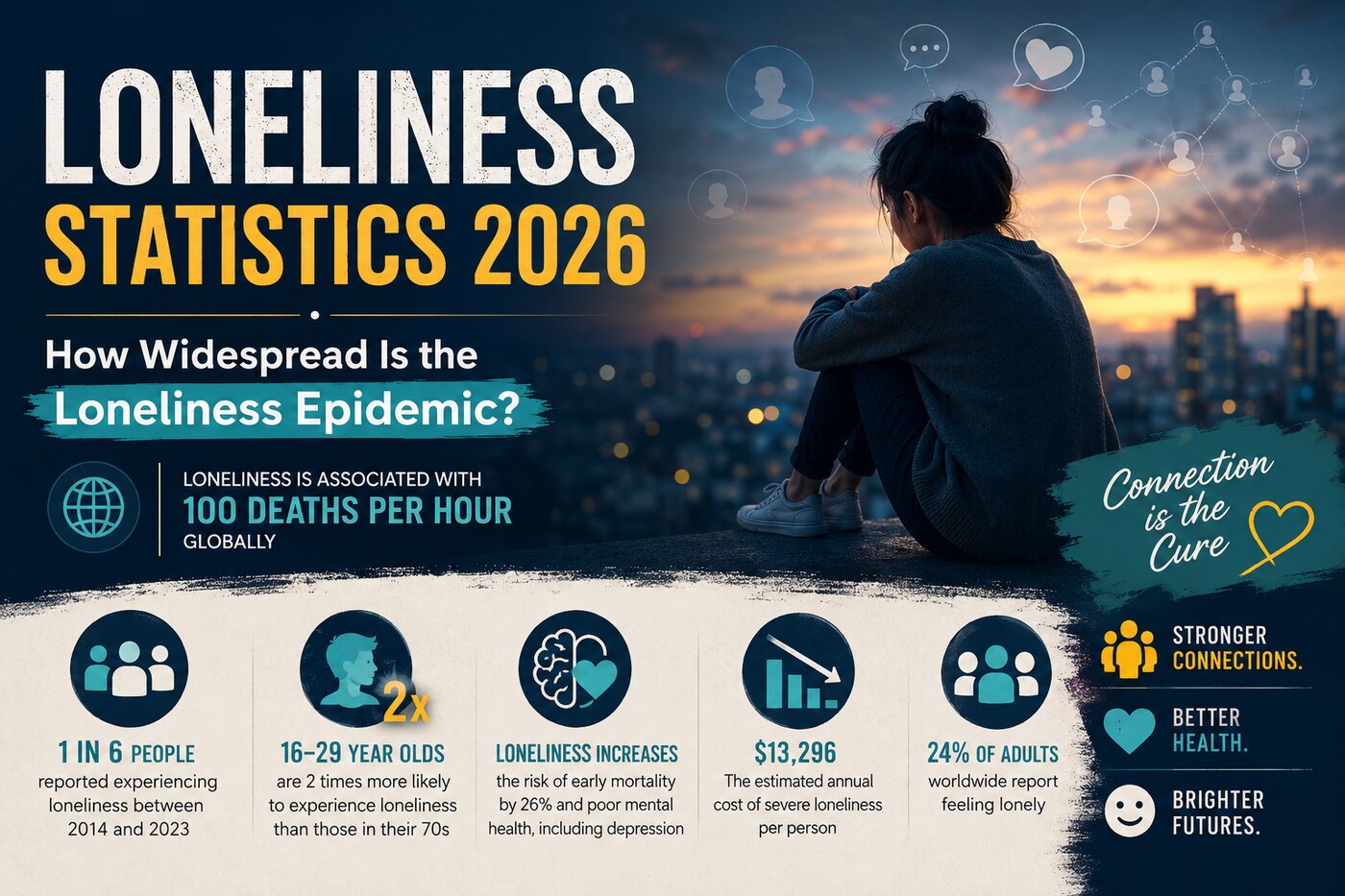
Loneliness can affect anyone, but the sheer scale at which people are getting trapped by the modern malaise of loneliness is concerning. So much so that loneliness has become the defining health crisis of our times, if the World Health Organization's Commission on Social Connection is to be believed. Nearly 1 out of 6 people reported experiencing loneliness between 2014 and 2023, with the experience significantly higher among young adults and adolescents. This loneliness epidemic has reached such alarming proportions that the US Surgeon General had to issue a major advisory in 2023 about not just the emotional aspects of loneliness, but also the physical and economic aspects. According to the WHO's June 2025 report, loneliness is associated with around 100 deaths per hour globally. That's not all — stress-related absenteeism from work costs US employers an estimated $154 billion annually.
These numbers point to a more grave situation than one can imagine. Each statistic reflects a lonely person eating their dinner alone, another who has millions of online connections but no one to call in a moment of crisis, yet another who weeps alone and has no shoulder to cry on. The ripple effects of loneliness extend far beyond mere sadness, as many chronic lifestyle diseases are added on due to the condition, such as coronary heart disease and type 2 diabetes. That's not all — loneliness gives rise to cognitive decline and several mental health conditions, including anxiety, depression, substance use disorder, and post-traumatic stress disorder. We at Call Your Girlfriend pulled together the most credible loneliness statistics — from the WHO, the US Surgeon General, and Gallup — to show how widespread the condition is, and what can be done to combat it. It's also the backdrop to everything we cover: the gap these numbers describe is exactly the one AI companion apps are now built to fill.
Loneliness Affects People of All Ages
The statistics presented below were reported by Loneliness Awareness Week:
- 16–29 year olds were 2 times more likely to experience loneliness than those in their 70s.
- People who are widowed, with poorer health, and those with long-term illness or disability are far more likely to experience loneliness.
- About 45% of adults feel occasionally or often lonely in England.
- About 2 million of those over 50 experience loneliness in 2025–2026, as opposed to 1.4 million in 2016–2017 — a sharp 49% increase in 10 years.
- Around 500,000 people go 5–6 days a week without seeing or speaking to anyone.
- ⅖ of all older people (about 3.9 million) say they watch television to ease their loneliness.
- 30% of those aged 18–34 experience frequent loneliness. In contrast, 17% of adults aged 65 report similar feelings.
- To put things in a global perspective, approximately 24% of adults above the age of 15 experience loneliness.
- 27% of 19–29 year olds experience loneliness.
- Around 79% of Gen Z reported feelings of isolation, according to Cigna — compared with 71% of Millennials and 50% of Baby Boomers.
The digital landscape offers a ready respite to those who are seeking to soothe their loneliness. When comparing loneliness across generations, it is clear that Gen Z is the loneliest generation, followed at its tails by Millennials and the older generation. When setting out to ease the loneliness epidemic, understanding the differences in loneliness experienced by different generations is paramount. Since Gen Z is the loneliest, fostering a sense of community and mental wellness — even online — can help this generation feel a little less lonely. It's also why so many are turning to AI for companionship, a shift we've spent months testing first-hand.
Experiencing Loneliness in the Workplace
The experience of loneliness can vary in intensity. Loneliness by itself is a negative emotional experience, indicating an unmet need for social connection and acceptance. Lonely people may experience unwarranted feelings of sadness, disconnection, and isolation. Experiences of loneliness can differ in their intensity, changing from one moment to the next, and even in different life contexts. For example, considering loneliness at the workplace, a recent study had these findings to share:
- Around 1 out of 10 workers feel lonely at work often or always.
- Around 1 out of 2 people experience loneliness some of the time.
- Although recent changes to work patterns have 19% of people working from home and 24% working hybrid, this does not seem to have accelerated loneliness. In fact, changes in work location during the COVID-19 pandemic gave many people a chance to improve their relationships with their loved ones.
- There is little evidence to suggest that merely staying in touch with colleagues leads to less loneliness at work, since loneliness is not the same as isolation.
Certain factors can increase the risks for loneliness, such as ethnicity, age, disability, and life circumstances — like living alone, going through life changes, and living in certain areas.
Impact of Loneliness on Health
Feeling lonely from time to time is an expected life occurrence, yet chronic loneliness can have negative impacts on one's life. Here are some alarming statistics related to the impact of loneliness on people's health:
- Loneliness can increase the risk of early mortality by 26%.
- Loneliness can increase the risk of people experiencing poorer mental health, including depression.
- 60% of the people experiencing chronic loneliness also experience mental distress, compared to 15% who said that they were not chronically lonely.
- According to 62% of young adults, feeling lonely makes them lose confidence in themselves.
- Loneliness is associated with high blood pressure and an acute stress response.
- Loneliness is associated with poorer sleep quality in young adults, and sleep inadequacy and dissatisfaction in the general population.
If you're noticing these patterns in your own use of an app or a chatbot, our guide on recognizing emotional dependence is a good place to start.
Impact of Loneliness on Education & Employment
- Loneliness in early adolescence is associated with lower educational attainment.
- 48% of lonely young people are demotivated to make progress in their work.
- Higher loneliness among employees is associated with poor work performance.
- A recent study estimates that the cost of severe loneliness is around $13,296 per person per year, due to loneliness' combined impact on health, wellbeing, and work productivity.
- Loneliness costs UK adults nearly £3 billion due to its impact on employee sickness, caring activity, productivity, and voluntary staff turnover.
Loneliness in Different Countries
Loneliness differs from country to country. A global Meta-Gallup survey revealed that approximately 24% of adults report feeling lonely. Likewise:
- 45% of adults in Comoros reported feeling lonely.
- Just 6% of Vietnam's adults reported loneliness.
- In the United States, 21% of adults — particularly young adults — report loneliness. That is approximately 52 million US adults.
- 30% of adults experience loneliness at least once a week, whereas 10% experience loneliness every day.
Impact of Cultural & Socioeconomic Factors on Loneliness
Different life circumstances and socioeconomic factors can have differing effects on loneliness. Loneliness is a complex occurrence associated with the confluence of geography, age, and economic fluctuations. Understanding these factors can help create targeted strategies to address loneliness from the ground up.
- 32% of individuals who face financial stress are reported to be more lonely.
- Only 15% of those who are financially stable report loneliness.
When financial institutions face problems, or when people undergo their own personal financial problems, they can report exacerbated feelings of loneliness. Research reveals that people feel disconnected from the broader society not only because of their personal limitations but also due to broader socioeconomic factors that influence an individual's sense of community. That's not all — certain social elements add to a sense of non-belonging. For example, many adults report feeling isolated and lonely despite being part of a thriving social circle, which further exacerbates their sense of isolation. Both economic and social factors are crucial to finding harmony and belonging within communities.
How to Combat Loneliness
Loneliness can be eased by a multi-pronged approach. Individuals can take personal steps by reaching out to friends and family, joining social clubs, or taking part in group activities that align with their interests. They can also participate in volunteer or community work, which can create meaning and a sense of belonging.
Public Health Strategies
Seeing that loneliness is a public health concern as much as it is a personal one, public health bodies can design intervention programs to target the most vulnerable demographic of the loneliness epidemic. Mental health support and awareness campaigns that emphasize the importance of social connections can be some such programs. Support groups and online communities for those feeling isolated and detached from the wider world can come in handy.
Fostering Connections With the Community
Feeling part of the larger community is crucial. Loneliness-eradication organizations and local governments can organize gatherings, events, and workshops designed to help people come together. Encouraging neighborhood events such as potlucks and group exercise classes can also help build bonds and reduce feelings of loneliness. If these strategies are properly implemented at the personal and community level, they can greatly reduce feelings of loneliness and restore a sense of community and well-being.
Conclusion: Let's Fight the Loneliness Epidemic Together
Loneliness continues to be a pervasive and widespread issue affecting millions throughout the world, of all age groups. It has significant social, financial, health, educational, and employment impacts. However, there are some readily available solutions which can help authorities combat the wide-ranging effects of loneliness.
Public health initiatives can focus on forging a feeling of community and connection, promoting mental health awareness, and enhancing social support networks. Loneliness is multi-pronged and affects demographics across regions. With the aim of understanding loneliness, authorities can tailor targeted approaches for lessening it and improving overall well-being. As we walk together to understand this phenomenon and devise strategies to combat it, we must prioritize inclusivity and empathy in forging stronger community ties and bridging gaps — including the new, complicated ways people are reaching for connection, from group chats to AI companions — a demand we trace in our report on the loneliness economy.