
Across the digital landscape, lonely people are finding new meaning in intimate relationships with "virtual humans" — AIs, chatbots, and avatars. Technology now produces humanlike bots that mimic your personality and fill a social void on demand. Picture this: a woman in Shanghai talking to an AI boyfriend on her commute. A Tokyo salaryman booking a soine-ya (cuddle café). A Brooklyn woman sexting someone she'll never meet.
What do these scenarios have in common? The growing entanglement of people's most intimate sides with their digital companions. But what do these companionships mean for non-virtual human intimacy and connection? Is it just a playful curiosity that drives people to develop intimate connections, or is there more at stake? It's like an episode of Black Mirror or the movie "Her" coming alive, but at a much grander scale, in places such as Japan, China, or the West.
Let us explore how digital intimacy is a growing cultural phenomenon in the places mentioned above, and the new meanings humans have begun to assign to "love." From the first-wave digisexuals who used dating apps to find human connections to the second-wave digisexuals who have eliminated the "human" aspect of romance and find technology integral in forming their sexual identity, this blog shall feature it all. (For a closer look at how this shift is reshaping dating itself, see How AI Is Changing Modern Relationships.)
Intimacy at a Distance Is Older Than Your Phone
Before the Luddites start dismantling their handheld devices, calling an end to all forms of digital connection, they must be reminded that long-distance intimacy has always existed throughout human history. Personalities, both significant and common, have yearned and pined for their lover from a distance, finding creative new ways to display their affection.
Heian-era love letters and the poetry of longing in Japan
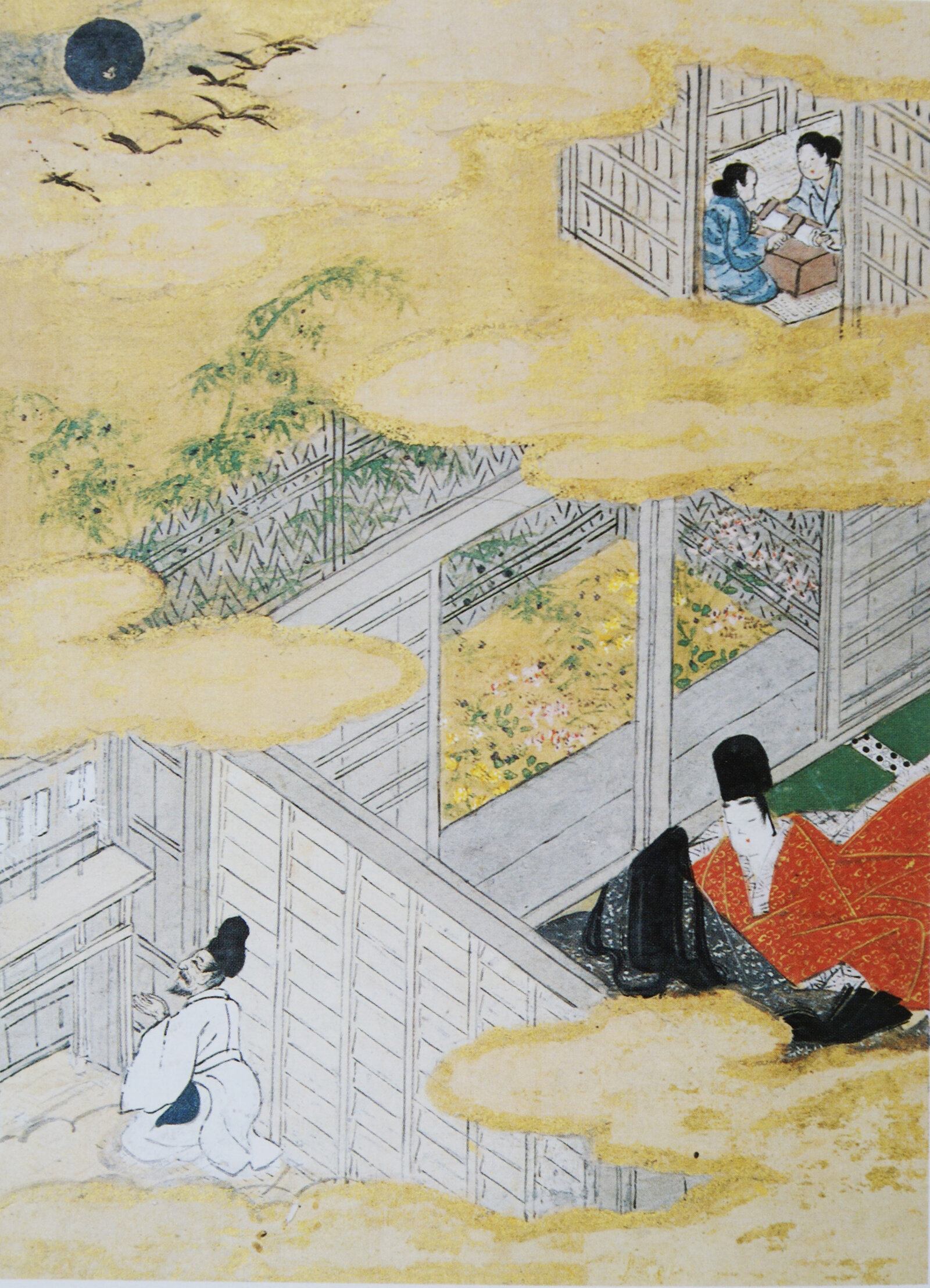 A 12th-century illustrated handscroll from The Tale of Genji — courtship in the Heian court was conducted almost entirely through letters and poems. (Public domain, via Wikimedia Commons)
Take, for example, the exchange of love letters, particularly poems, during the Heian period (794–1185) in Japan. Poetic exchange was the chief method of courtship in Japan during that era, and this led to poems of lovers being part of the classic prose of this period, as well as in poetry collections still relevant in the Edo period. Poetry was the staple of an aristocratic life, and the famous poetesses such as Ono no Komachi and Izumi Shikibu became famous, or infamous, for their poetry. Komachi helped to usher in personal poetry that was romantic or erotic in nature. Shikibu, too, wrote poetry at the pinnacle of the poetry culture in Japan, which blended themes of eroticism and spirituality.
The matchmaker's ledger in China
Much like modern dating apps, the matchmaker's ledger existed in China. The first imperial marriage broker in the late Zhou dynasty is credited with starting China's institutional matchmaking custom over 2,000 years ago. XiangQin is the traditional term for meeting or dating between two people of opposite sex, arranged by a third party, such as relatives, parents, neighbors, coworkers, or even matchmakers. Such a system evades direct communication with one's potential long-term partner and instead uses an intermediary, just like with a modern dating app.
Lonely Hearts and Party Lines
The West wasn't too far behind in expressing affection for their beloved from a distance. The epistolary romances of the 18th century are a prime example of this. Coming from the Greek word epistole, meaning "letter," these romances were carried forward through the exchange of letters between two or even among three people. Jay Dixon contends in her essay "English Romance Novels, 1621–1975" that Love-Letters established the foundation for many of the stereotypes that define the contemporary romance genre. The epistolary form, which was popular in the 17th and 18th centuries, was particularly conducive to transgressive romance because it gave people the opportunity to communicate private ideas that they would never be able to express openly in a morally constrictive society.
Then came the private advertisements of the Victorian era, which were popular in newspapers to find spouses. These ads empowered individuals to overcome geographical and social limitations to find a companion at a distance. Such a method of finding companions was popular in mobile America and rural areas. And who can forget the party lines? In the mid-1980s, teenagers used a group phone call called the "party line" to meet new people. Consider it the forerunner of the online chat room.
Japan: Intimacy as Craft, Intimacy as Service
Loneliness is a staggeringly common feeling among the Japanese, and sometimes it cripples the strongest. However, the Japanese economy has found creative new solutions to this apparent societal burden in the form of host/hostess clubs, as well as rental family services. But the consolation to the lonely does not just end there, as modern outlets are constantly devised to seek companionship, even if temporary, virtual, or paid.
The rental economy of feeling
In Japanese rental family services, paid actors are employed to play parents, spouses, children, friends, or coworkers. In the most extreme circumstances, it may last for months or even years, but occasionally it only lasts for a single incident. The concept fills a real need even though it sounds ridiculous. The industry started to take shape in the early 1990s when a corporate training organization saw that its clients were unhappy with their personal lives. In the early 2000s, companies began renting out wedding guests and acting as stand-in relatives for a society that cherishes family relationships.
Then there are the host/hostess clubs, which add vibrancy to the Japanese nightlife. A popular option for many Japanese men on a night out, hostess clubs are places in Japan's nightlife districts where men pay to converse and drink with attractive and charming women. The two main types of hostess clubs are kurabus and kyabakuras. Conversely, there are host clubs for lonely Japanese women, where young guys offer drinks to women while engaging them in conversation. A group may spend hundreds of thousands of yen, sometimes even millions, on a single evening.
Loving the 2D
 Hatsune Miku performs as a 3D CG projection at the Hokkaido University Festival, 2024. Photo: MIKI Yoshihito, CC BY 2.0, via Wikimedia Commons.
Some lonely souls have taken recourse in loving what they see on their screens, quite literally. For example, there are otome games for women. These are video games with female protagonists targeted towards women, employing simple user controls and multimedia. The traditional objective of these games is for the player character to fall in love and form a relationship with the desired partner; however, the conditions for achieving a "good end" vary from game to game. Otome games often feature a single female protagonist and several attractive males of various "types," despite the fact that their narratives vary widely.
And who can forget the famous lore of the man who married Hatsune Miku — the famous anime character? Akihiko Kondo started dating a computer-generated hologram of the anime heroine Hatsune Miku after battling depression and social isolation for several years. He eventually proposed marriage to the hologram. His case is not an isolated one, as more than 3,000 people have registered commemorative marriage certificates featuring their favorite anime character since Vinclu began offering the service in 2017.
Herbivore men and the opt-out generation
The toughest among the loneliest Japanese cohort is perhaps the herbivore men and the opt-out generation. "Herbivores" are men who claim that they are heterosexual but are not interested in having sex with women. In sharp contrast to the traditional "Japanese salaryman" culture, such men stay with their friends and family, drawn to quieter, less-competitive lifestyles. Not far behind is the "opt-out" generation, the generation that graduated between 1994 and 2004, when the Japanese economic miracle bubble burst, leading to an "Employment Ice Age." Unable to secure permanent, full-time roles at prestigious companies, this generation resorted to part-time gigs, essentially "opting out" of the traditional family structure inherent in Japanese culture. What is the last resort for this generation to find intimacy? The same as herbivore men. Digital companions that don't demand what human companions otherwise would.
China: Intimacy Under Surveillance and Acceleration
Digital technology accelerated at a breakneck speed in China, and with it, pervasive mass surveillance. The amalgamation of state surveillance, big data, and artificial intelligence translated into intrusive state scrutiny of people's most intimate, private lives. This has led to the "surveillance of intimate technologies." Let us explore how the Chinese navigate the murky waters of feeling and expressing intimacy under surveillance.
Swipe culture with Chinese characteristics
A few dating applications that take into consideration China's distinct social setting are Fanka, HIMMR, and Slow. Chinese millennials and Gen Z are increasingly drawn to local applications that offer specialized cultural solutions. In contrast, a few years ago, Western apps like Tinder, Bumble, and Grindr, together with their Chinese counterparts, dominated the nation's online dating market.
The apps mentioned here are relatively nascent, while their more predominant counterparts, such as Momo, Tantan, and Soul, boast millions of daily active users. Users predominantly look for a potential companion's social status through their education, income, and university prestige, reflecting a desire to maintain their social standing in the highly competitive Chinese culture. That aside, most dating app users look for marriage prospects in their partners, as opposed to the "Western hookup culture," since dating before college is often shunned in Chinese society.
The parasocial economy
TikTok and Taobao livestream commerce have seen a huge uptick, especially since the COVID-19 pandemic. These platforms invite internet celebrities to leverage their parasocial relationships to increase conversions and boost sales in China. Parasocial relationships refer to the one-way intimate bonds developed between internet celebrities and their Chinese users. This relationship prompts users to send gifts and express affection for their favorite digital creator through tips, such as sending stickers (which can be cashed for actual currency) on TikTok livestreams. Alternatively, users trust the brands endorsed by their favorite internet celebrity to be in their best interests. Then, there's the Xiaohongshu phenomenon, converting lifestyle content into casual connections among users. It's not a dating platform, yet it has been turned into one that lets users connect based on shared preferences, since they trust content created by their peers rather than that which is highly polished by a marketing agency. (For more on how these one-way bonds slide into dependence, see Recognizing AI Emotional Dependence.)
The West: Intimacy as Self-Actualization (and Self-Branding)
Intimacy is no longer viewed as a private emotional feeling, but rather as a tool for self-actualization and self-branding, at least in the West. It reflects an almost modern, entrepreneurial approach to personal relationships and identity. In a late, unstable market, personal branding has become a survival skill — and the most intimate parts of life, from how we date to how we mourn, are folded into that performance, every connection a chance to refine the self.
App fatigue and the death of the meet-cute
Meet-cutes are important because they signal to the people involved that the moment they're sharing is the start of something significant. A meet-cute refers to a plot device in rom-coms and romance novels, introduced to make characters fall in love with each other. Soon, this term infiltrated real life, where couples began to describe the first moment they met each other and started their own love story. Today, what started as a mere narrative tool has become a cultural obsession thanks to social media. Couples create lengthy videos to describe how they first actually met, but rarely through online dating apps. This is because dating apps in the West have killed the "Meet-Cute," to put it mildly. People now hide behind technology's pre-engineered profiles to appear fabricated and inauthentic.
Now, instead of saying that they met at a bookstore or a football match, a couple would rather not take the risk of rejection and try to find each other on dating apps. Thus, dating apps, while providing autonomy and the prospect of self-marketization to individuals to project their "best selves" to the world, have also eradicated the role of luck and spontaneity in the finding of love. Safe to say, "meet cute" has now been replaced by "meet pre-fabricated," thanks to online dating spelling fatigue for millions of app users.
Monetized intimacy through OnlyFans, Paid DMs, and online sex work
Intimate loneliness finds reprieve in online sex work, particularly camming — where models broadcast through computer, camera, and microphone in exchange for tips and subscriptions. What sets camming apart from earlier categories of sex work is its demand for authenticity and conversation. There's no physical contact, as in prostitution, and no passive viewing, as in pornography; the client participates, asks questions, builds a (transactional) rapport. OnlyFans extends the same logic to direct messages and pay-per-view media — intimacy converted into a recurring subscription, monetised by the minute.
The loneliness epidemic discourse
The loneliness epidemic is a widely recognized social phenomenon at the global stage, driven by factors such as tech advancements, personal preferences, urbanization, and economic individualism. The large proportion at the receiving end of this phenomenon is men, who find it difficult to connect with peer groups of the same or opposite gender. The media purportedly reports on rising male loneliness epidemics, where high suicide rates, shrinking friend circles, and a chasm between expectations and reality are some major contributory factors. While often framed as a personal issue, the problem arises due to systemic economic and cultural issues, especially the erosion of community ties. The COVID-19 pandemic has apparently exacerbated the problem. (The data behind this trend is unpacked in AI Girlfriend Statistics 2025.)
What Crosses Borders, What Doesn't
Across China, Japan, and the West, one factor remains common: loneliness is a shared universal experience. That loneliness is finding outlets for relief through parasocial relationships, AI companions, and paid online sex work. This has given rise to a massive global loneliness economy, where real money is minted through people's desire to be seen, heard, and cherished. Whether it is a Japanese salaryman wanting to experience the comfort of a wife and child, even if rented, a Chinese college student finding solace in her AI boyfriend, or an American man subscribing to OnlyFans to experience sexual intimacy at a distance, all cultures have found ways to cope with the alienating effects of modernity.
However, not all facets of alleviating loneliness can be considered universal. Nowhere is this contrast sharper than in China, where the state plays an important role in the digital intimacy people are allowed to experience. By placing tight controls over what kind of technology companies are supposed to dole out, the state weaves matters of national importance, such as the declining birth rate, into people's behavioral decisions towards intimacy. While in the West, displaying intimacy publicly has been normalized, in Eastern cultures, it is generally experienced privately through handheld devices, such as in the case of otome games, or through private host/hostess clubs.
Conclusion: I am here. Do you see me?
The most honest conclusion of this cross-cultural analysis may be that digital intimacy is not supplanting human connection; instead, it underscores the fragility and socially constructed nature of our initial perceptions of "genuine" connection. A thousand years of technological progress separate the answer of an AI chatbot at two in the morning from a poem sent by a messenger in the Heian period, but they both have the same basic message: I am here. Do you see me?
It turns out that borders between countries aren't the most important ones. They are the lines that separate being real from acting, the connection we really need from the love we were taught to want, and being alone from being part of something. Digital intimacy is just the latest way that people have tried to get around their problems, even though it has a lot of flaws and is too commercial.