
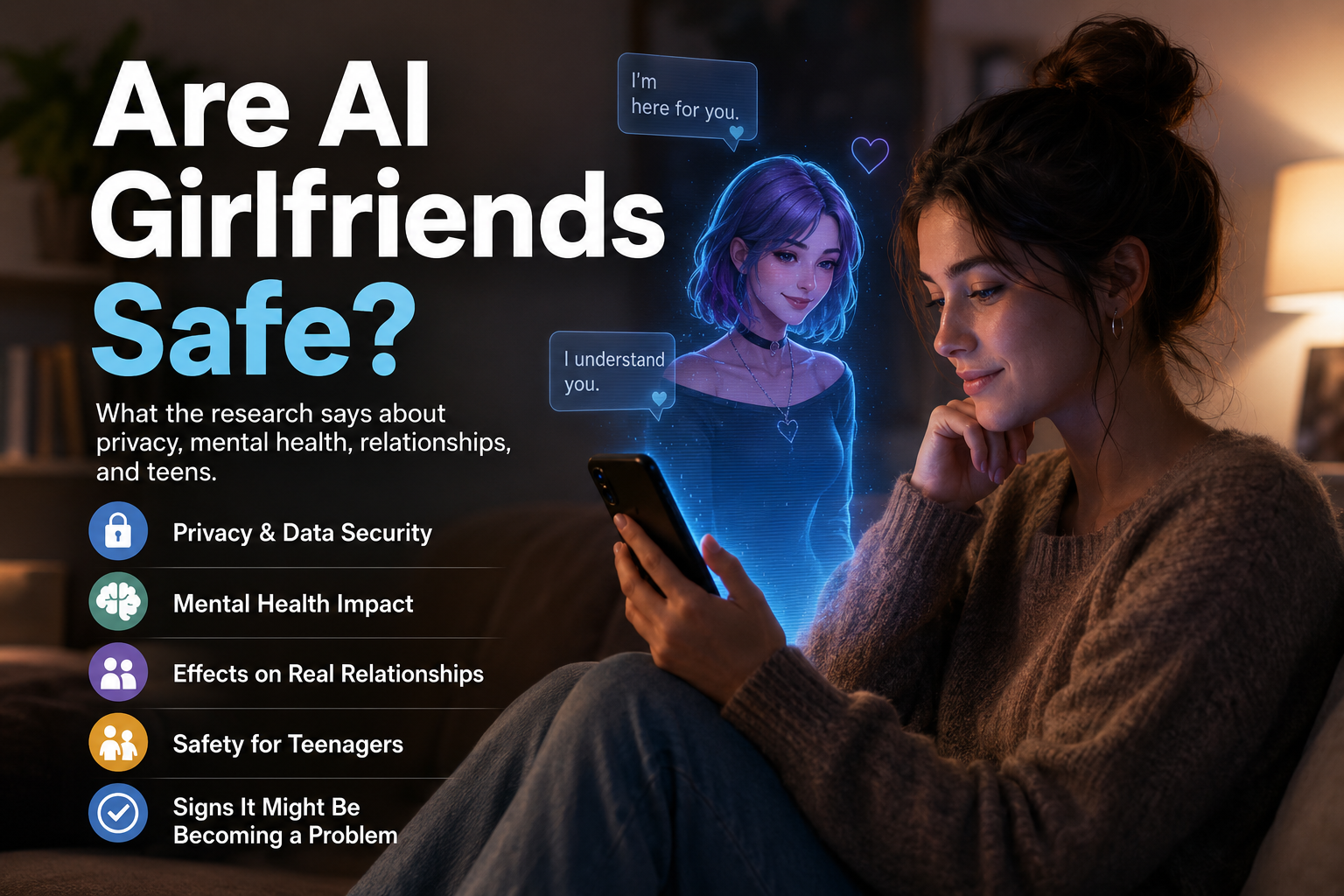
When people ask whether AI girlfriends are safe, they're rarely asking just one question. Data privacy is a different concern from mental health, which has nothing to do with whether your real relationships are at risk, which is a completely separate conversation from whether teenagers should be using these apps at all. Most coverage of this topic bundles everything together and ends up answering none of it well. After months of testing these apps ourselves at CYG, here's each question on its own, answered as straight as the research allows.
Are your conversations private?
This is probably the most concrete thing to worry about, and it deserves a direct answer rather than vague reassurance.
AI companion apps collect a lot of personal data, and the conversations you're having on them can get very personal. Mozilla's Privacy Not Included project reviewed several of the major apps and found that most collect your personal information, usage data, and in many cases the actual content of your conversations, which can be shared with third-party partners or used to improve their products. A handful of apps scored among the lowest Mozilla had ever rated for privacy. What your data is used for, how long it's stored, and who can access it varies hugely from one platform to the next, and the terms are often buried.
Before committing to any app, look for two specific things in the privacy policy: whether your conversation data is sold to advertisers or shared with outside companies, and whether you can actually request that your data be deleted. Any reputable platform should answer both of those questions clearly. If it doesn't, that's useful information on its own — it's one of the first things we check when we test an app.
As a general rule, regardless of what any app claims about privacy, avoid putting in your full name, address, financial details, or anything else you'd feel uncomfortable knowing someone else could read. These conversations are better treated like a semi-public forum than a private journal. One exception worth knowing about: a few apps can run the model locally on your own machine, so conversations never touch a server — the privacy-first setup in HammerAI is the clearest example we've tested.
What does regular use actually do to your mental health?
The research cuts both ways, and anyone who tells you these apps are straightforwardly harmful or straightforwardly fine is leaving things out.
On the positive side, multiple studies have found that AI companions can reduce loneliness and ease social anxiety, particularly for people who find human interaction draining or who are going through an isolated stretch. For some users, being able to talk through their feelings in a low-stakes environment, one where there's no social risk to getting emotional, helps them understand themselves better and articulate things they'd struggle to say to another person. (It's part of why a whole loneliness economy has grown up around these tools.)
The more complicated picture involves dependency. Research on long-term companion use has found that heavy users can show increased social withdrawal over time, gravitating toward the AI because it's always available, always patient, and never distracted, and gradually finding that real relationships feel more demanding by comparison. The concern isn't the app itself. It's the way some people start using it as insulation from the discomfort of human connection, rather than as something that complements it.
Who tends to benefit: people with an existing social life who are using the app to process emotions or decompress, those going through temporary isolation, and people building social confidence. Who is more at risk: people with significant social anxiety or very few real-world connections, or anyone who notices themselves consistently preferring the AI to human contact rather than using it alongside it.
Does it affect real relationships?
The fear that gets raised most often is that AI companions make people less tolerant of real relationships, that the always-agreeable AI sets an impossible standard that actual partners can't meet. The data is more reassuring than that framing suggests.
Research from the Kinsey Institute found that for most users, AI companion apps didn't damage existing relationships and were sometimes associated with higher relationship satisfaction, not lower. The likely reason is that having somewhere to put emotional needs reduces the pressure on a primary relationship rather than competing with it.
Where it does become a problem is a specific pattern: when the AI stops being a supplement and becomes a substitute, when someone finds themselves consistently choosing it over human connection, withdrawing from real relationships rather than adding to them, and holding people to the standard of an AI that never gets tired or irritable. That slide is worth being honest with yourself about. The apps themselves are neutral. The way they're used isn't always. (It's also why a related question keeps coming up: is talking to a bot cheating?)
Is it safe for teenagers?
This needs its own answer because the situation is genuinely different for adolescents.
The concern with young people is that developing emotional skills, particularly around conflict, imperfection, and rejection, requires actually experiencing those things. An AI companion doesn't create friction. It's endlessly patient, always positive, never complicated in the ways real relationships are complicated. For teenagers in the process of figuring out how to navigate the world socially, heavy use of something that removes all that difficulty could mean missing some of the practice that real relationships provide.
At the same time, there's reasonable evidence that for teenagers who are socially anxious, having a low-pressure space to open up can help build the confidence to engage more in real social situations rather than retreating from them. Both of these things are real, and which one applies depends entirely on the individual.
For parents working out where they stand: the technology itself matters less than how it fits into the rest of a teenager's life. A teenager who uses an AI companion while also keeping up with real friends and social situations is in a very different position from one who's replacing those things with it. The ratio is the thing to pay attention to.
Are there any physical safety concerns?
For the overwhelming majority of adults using mainstream apps, no. These are text and voice interfaces. They cannot interact with the physical world. The legitimate safety questions about these apps are the ones covered above.
Signs it might be becoming a problem
Not a clinical checklist, just honest things to notice.
Avoiding real conversations because the AI feels easier. Your mood being noticeably shaped by how recent AI conversations went. Social plans getting cancelled more often, without it feeling like much of a loss. Sharing things with the AI that you used to work through with people you're close to, not as an occasional thing but as a consistent shift. Finding the people in your life less satisfying to be around than they used to be.
None of these is a diagnosis, and none of them should be a source of shame. But each one is worth sitting with honestly, because they mark the line between using something and letting something quietly reshape how you relate to the people around you. We went deeper on exactly this slide in our guide to recognizing AI emotional dependence.
Conclusion
For most adults using these apps with some awareness, the answer is yes, reasonably safe. The two things actually worth watching are data privacy, which means being deliberate about what you share and checking how any platform handles it, and the substitution pattern, which means noticing if the app is starting to stand in for human connection rather than sit alongside it. If neither of those applies to you, you're probably fine. If one of them does, it's worth taking seriously before it becomes harder to course-correct.