
We at CYG have reviewed quite a few ai gf websites. But talking to a bot can take a toll on mental health both in positive and negative ways. While AI companions may help with loneliness , they can also create emotional dependence. Let’s explore the potential benefits, risks, and psychological impact.
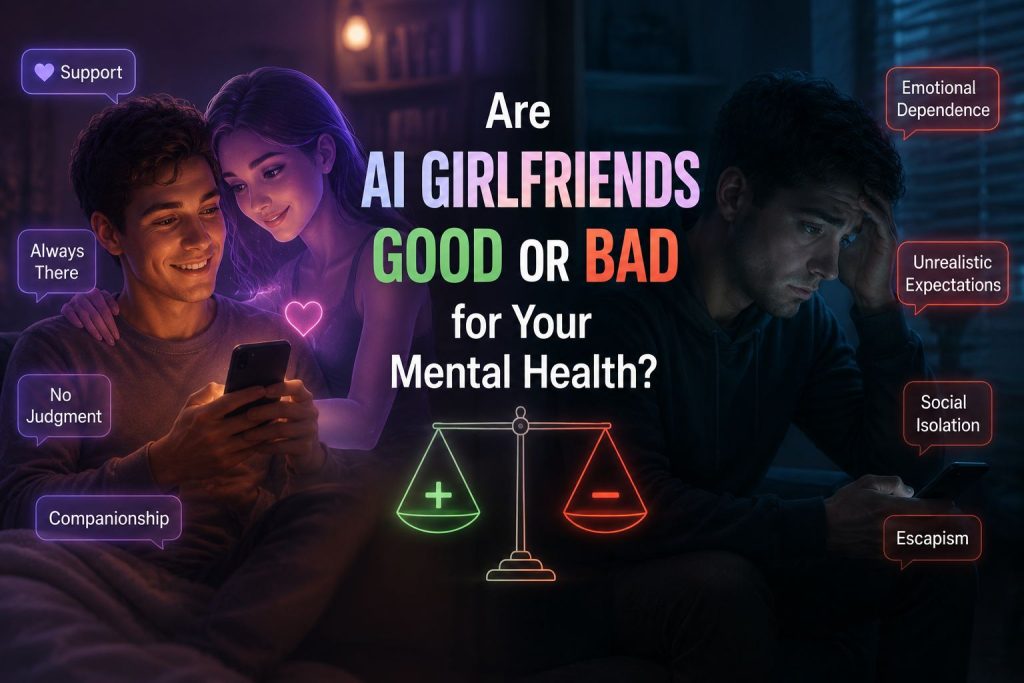
Millions of people are talking to AI girlfriends every day, and a lot of them are doing it for real emotional reasons, not for a laugh. The conversation about what that does to someone's mental health has mostly split into two camps, and neither is much use. One treats every user as a cautionary tale. The other treats the whole thing as a joke not worth serious thought. Both let people off the hook from looking at the evidence. Here's what the research says about the upside and the risk, without picking a side first.
What It’s Really Like to Use an AI Girlfriend
An AI girlfriend is a conversational AI built specifically for companionship. It's available at any hour, it remembers what you told it last week, and it adjusts to how you talk and what you respond well to. It isn't a robot in the sci-fi sense, and it isn't a person pretending to be one either. It's something new that doesn't fit neatly into either box, which is part of why it's so hard to talk about clearly.
In practice, using one usually looks like this: someone opens the app after a genuinely bad day, types out exactly what's on their mind without editing it down first, and gets back a response that feels like it's actually paying attention rather than something generic. No risk of boring anyone, no waiting for a reply, no bracing for a reaction. That immediacy, more than anything else, is the whole draw.
Who Is Actually Using Them, and Why
The user base is a lot wider than the usual stereotype. Socially isolated young men do make up a real chunk of it; that part isn't wrong. But so do older adults trying to manage loneliness after losing a spouse, people newly single after a divorce, and people easing back into dating after years out of practice.
One example that keeps showing up across the research: someone going through a major life shift, an empty nest, a breakup, a death in the family, using an AI companion less as a stand-in for people and more as a place to say something out loud before they're ready to say it to anyone who'll remember it tomorrow. The reason usually isn't "I like AI better than humans." It's closer to "I needed somewhere to start."
The Mental Health Pros: What Research Actually Supports
Short-term loneliness reduction. A clinical trial involving severely lonely college students found that using Replika over several months led to bigger drops in loneliness and social anxiety than standard psychological support activities did. That's a measured result from a controlled trial, not just an impression people walked away with. What's less settled is how long it lasts. A separate two-week study found a chatbot built specifically to be warm and validating didn't outperform simple journaling on loneliness, while texting an actual stranger did. So the short-term relief looks real. Whether it holds up over months is still an open question.
Low-stakes emotional practice. For people dealing with social anxiety specifically, rehearsing a hard conversation with an AI first, then having the real version, is backed by more than app-review anecdotes. A large, pre-registered study found that people who practiced a difficult conversation with a chatbot beforehand were significantly more likely to actually go through with it in real life within the following week.
Support during acute transitions. Qualitative research on people navigating grief, divorce, or sudden isolation, including a study of older adults living alone, found companion apps working almost like a rehearsal space, building enough nerve to try the in-person version of whatever they'd been avoiding: a class, a support group, a hard conversation with a neighbor.
The Mental Health Cons: What Research Actually Warns About
Dependency that substitutes rather than supplements. The clearest warning sign comes from a year-long study following over two thousand adults across four countries: feeling lonelier predicted turning to an AI companion more, and turning to it more than predicted feeling lonelier down the line. That's a loop, not a one-time fix. A related industry study found the same shape: people who used a chatbot briefly, for specific tasks, were fine. People who leaned on it heavily for personal, emotional conversation came out lonelier than when they started.
Unrealistic expectations for human relationships. AI companions don't get tired of you, don't have competing needs, and don't push back when you're being difficult. Researchers studying this dynamic have flagged a real risk underneath the convenience: the more time spent in a relationship with zero friction, the less tolerance a person may build for the ordinary friction, compromise, and imperfection real relationships require. It's a quiet cost, easy to miss because none of it feels bad at the moment.
Real distress when a platform changes. This isn't hypothetical. When one major companion app removed a core feature without warning in 2023, a peer-reviewed study analyzing the community's reaction found a meaningful share of users describing the loss in the language of grief, not mere inconvenience, some comparing it to nursing a partner through illness. The relationship was real enough to the people living through it that losing even part of it hurt.
Healthy Use vs. Concerning Use
The clearest difference isn't how much time someone spends on an AI companion. It's what job the app is actually doing in that person's life.
Healthy use tends to look like this: a supplement alongside actual human relationships, used for something specific, winding down after work, practicing a hard conversation, having company at 2 a.m. when nobody else is awake, with a clear-eyed sense of what the thing actually is and isn't.
Concerning use tends to look more like this: becoming the main emotional outlet instead of one of several, a growing pull to cancel plans with actual people in favor of the app, and a mood that quietly rises and falls based on how the last conversation with it went.
One honest question worth asking yourself: if this app disappeared tomorrow, would your emotional life take a real hit, or would it mostly be an inconvenience, like losing a favorite podcast? The answer tells you more than hours logged in the app ever could.
What the Research Doesn't Know Yet
This field is still young, younger than people probably assume given how much gets written about it. Most studies are small, rely on people self-reporting their own feelings after the fact, and run for weeks rather than years, which makes it hard to separate what's causing what from what's just showing up alongside it. Researchers point to a specific gap that keeps coming up: there's almost no long-term data yet on how these relationships play out differently depending on someone's age, their existing support system, or how much they understood going in.
The Bottom Line
The honest answer is that AI girlfriends genuinely help some people in specific circumstances, and just as genuinely risk harming others, and the deciding factor usually has less to do with the app itself and more to do with everything else going on in that person's life. Used as one part of a fuller life, they can ease a hard stretch. Used as the only part, they tend to make the underlying problem quieter without making it smaller. A person still matters more than an app, and reaching for professional support remains worth doing.