
We're covering how AI is reshaping relationships — and we're starting with the numbers. Our team spent two weeks pulling data from industry reports, app store analytics, academic studies, and government surveys to put this together.
Here's the thing about AI girlfriends: a year ago, most people treated this as a curiosity. A weird corner of the internet. That's not what the data says anymore. The numbers point to something much bigger — a behavioral shift in how millions of people seek companionship.
We're going to walk through all of it. Market size, user demographics, revenue, engagement patterns, privacy risks, and what the actual research says about mental health effects. No fluff, just data.
Key Takeaways
The short version if you're in a hurry:
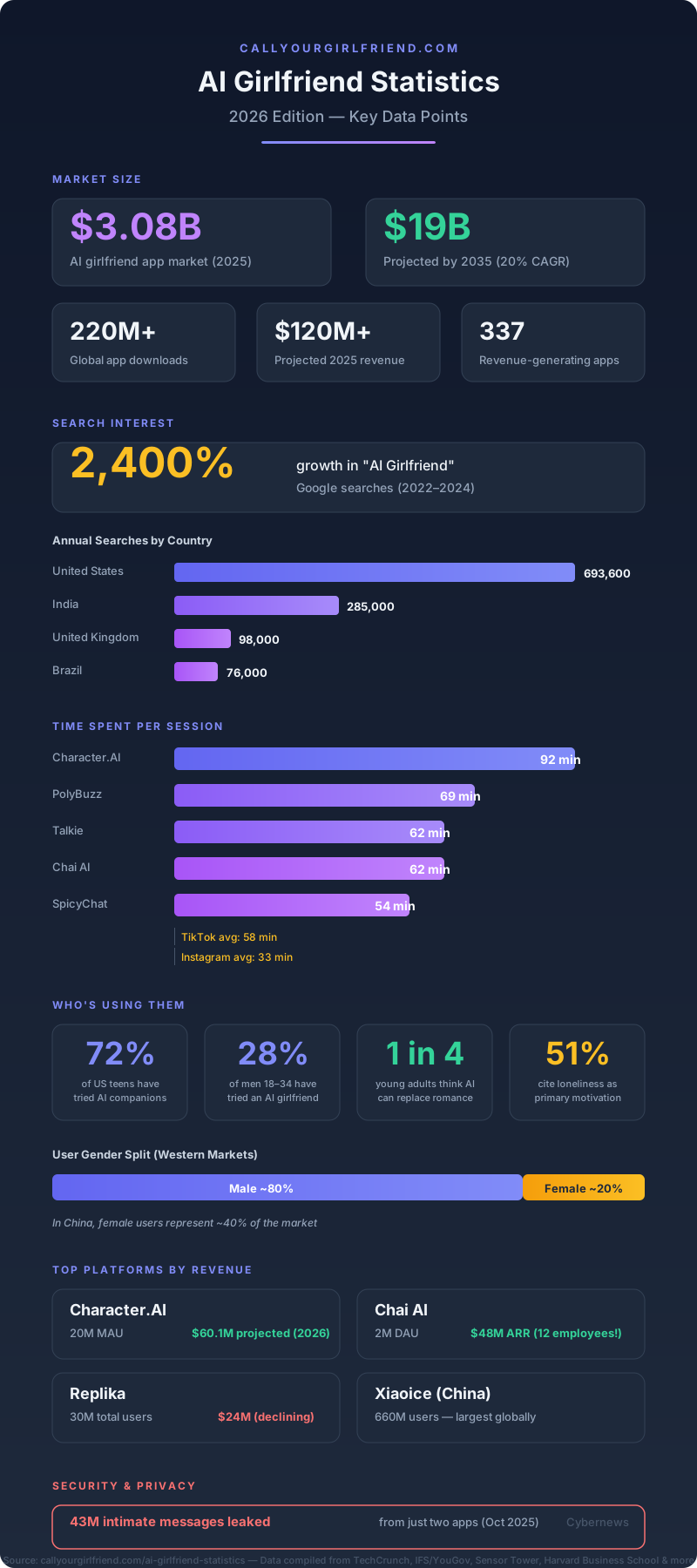
- AI companion apps have been downloaded over 220 million times globally
- The market hit roughly $3.08 billion in 2025 and is projected to reach $19 billion by 2035
- Character.AI users spend 92 minutes per session on average — longer than Instagram, TikTok, or YouTube
- 72% of US teens have tried an AI companion app
- More than half of AI girlfriend apps have critical security vulnerabilities
- 1 in 4 young adults believe AI could replace real-life romance
AI Girlfriend Market Size
The AI girlfriend market is not small, and it's not slowing down.
According to SNS Insider's market report, the AI girlfriend app market was valued at $3.08 billion in 2025, with projections putting it at $19.09 billion by 2035 — a compound annual growth rate of about 20%.
If you zoom out to include all AI companion applications (not just romantic ones), Precedence Research puts that broader market at $37.73 billion in 2025.
Here's how the app-level economics break down, based on Appfigures data reported by TechCrunch:
| Metric | Figure | Period |
|---|---|---|
| Cumulative global downloads | 220 million+ | Through mid-2025 |
| Downloads in first half of 2025 | 60 million | H1 2025 (up 88% year-over-year) |
| Revenue in first half of 2025 | $82 million | H1 2025 |
| Projected annual revenue | $120 million+ | Full year 2025 |
| Revenue per download | $1.18 | 2025 (up from $0.52 in 2024) |
| Active revenue-generating apps | 337 | As of mid-2025 |
| New apps launched | 128 | 2025 alone |
| Apps exceeding $1M lifetime revenue | 33 | Cumulative |
That revenue-per-download jump from $0.52 to $1.18 is worth paying attention to. It means users are increasingly willing to pay, and apps are getting better at converting free users into subscribers.
One more thing: the top 10% of apps capture 89% of all category revenue. This is a winner-take-most market.
What's Driving Growth
The growth isn't purely technological. It's driven by a few converging trends:
- Loneliness is widespread. The U.S. Surgeon General declared it an epidemic. Pew Research found that 63% of men under 30 are single, compared to 34% of women in the same age group.
- The AI got good enough. Modern language models produce responses that feel conversational, not scripted. Users report that conversations feel "real" within minutes.
- Smartphones made it frictionless. No downloads required for many web-based platforms. Others are one tap away on app stores.
- Personalization hooks people. Users can design appearance, personality, and conversation style. That level of control doesn't exist in human relationships.
Subscription models dominate the revenue side. When users form emotional connections, they come back daily — and monthly billing follows naturally.
Search Interest: How Big Is the Demand?
Google search data tells a clear story about how quickly interest exploded.
According to data from TRG Datacenters and Ahrefs:
- Searches for "AI Girlfriend" grew 2,400% between 2022 and 2024
- The term pulls roughly 1.6 million searches per year in English alone
- "AI Boyfriend" gets about 180,000 annual searches — nearly 9x less
- "Virtual girlfriend" searches are up 620% year-over-year
- "AI Companion" searches rose 490% in the US
Where the Searches Come From
| Country | Annual Searches for "AI Girlfriend" |
|---|---|
| United States | 693,600 |
| India | 285,000+ |
| United Kingdom | ~98,000 |
| Brazil | ~76,000 |
| Germany | ~54,000 |
The US dominates search interest, but the actual download distribution tells a different story. According to Sensor Tower data reported by ElectroIQ:
| Country | Share of AI Companion Downloads |
|---|---|
| United States | 16% |
| Philippines | 11% |
| Brazil | 10% |
| Indonesia | 8% |
| Mexico | 7% |
Southeast Asia and Latin America are quietly becoming massive markets. The Philippines at 11% of global downloads, with a fraction of the US population, signals strong per-capita adoption.
Who Uses AI Girlfriend Apps?
The stereotype is young men, and the data partially supports that — but the picture is more complex than most people assume.
Age Distribution
- Gen Z is the primary adopter. Roughly one-third of Gen Z users have tried some form of AI-based romance or companionship app.
- Millennials follow closely, particularly urban, tech-forward users in their late 20s and early 30s.
- The average AI girlfriend app user is 27 years old, according to What's the Big Data.
- And this one might surprise you: 72% of US teens have tried an AI companion app, with 52% being regular users (13% daily, 21% weekly), per a 2025 TechCrunch study.
That teen number is significant. This technology isn't something young people are encountering at the margins — it's mainstream among minors.
Gender Split
- Men make up roughly 78-82% of AI girlfriend app users in Western markets
- But AI boyfriend apps are growing. Female users represent about 18% of the US market and roughly 40% in China — suggesting the gender gap is cultural, not inherent
- 28% of males aged 18-34 have tried an AI girlfriend app at least once
Why People Use Them
An IFS/YouGov survey of 2,000 adults found some telling numbers:
- 25% of young adults (under 40) believe AI partners could replace real-life romance
- 28% of men vs. 22% of women hold that belief
- 7% of single young adults are open to having an AI romantic partner
- Yet 55% of young adults view AI companions as threatening or concerning
Other survey data points to the top motivations:
- Emotional validation without judgment — 51% cite loneliness as primary motivation
- 24/7 availability — no scheduling, no waiting
- Control over personality and behavior
- Zero risk of conflict or rejection
- A safe space for emotional venting
There's a tension in these numbers. People are simultaneously drawn to AI companions and worried about what they represent. That ambivalence shows up across almost every survey we found.
Platform Breakdown: Revenue and Users
Not all AI companion apps are created equal. Here's how the major platforms stack up — and our ai girls reviews cover each one in detail.
| Platform | Users | Revenue | Notable |
|---|---|---|---|
| Character.AI | 20M monthly active | $32.2M (2024), projected $60.1M (2026) | 185M monthly website visits, 18M chatbots created, valued at $1B |
| Replika | 30M total, ~2M monthly active | $24M (2024), down from $30M (2023) | 14 min avg daily session, revenue declining |
| Chai AI | 10M+ total, 2M daily active | $48M ARR (Oct 2025), up from $30M (Apr 2025) | Only 12 employees — $2.5M revenue per employee |
| Xiaoice (China) | 660M users | Not publicly disclosed | Largest AI companion platform globally |
A few things jump out.
Character.AI dominates engagement. Their 92-minute average session time is extraordinary — we'll get to that in the next section.
Chai AI is the efficiency story nobody's talking about. They went from $30 million ARR in April 2025 to $48 million by October — a 60% increase in six months. With 12 employees. That's $2.5 million in revenue per person. For context, Meta generates about $1.6 million per employee.
Replika is interesting for a different reason — it's shrinking. Revenue dropped from $30M to $24M between 2023 and 2024. Part of that is the fallout from their controversial decision to remove romantic features and then partially restore them. It's a case study in how fragile user trust is in this space.
How Much Time Do People Spend?
This is where AI girlfriends start to look less like apps and more like relationships.
Average daily session times, per Sensor Tower data reported by ElectroIQ:
| App | Avg. Minutes Per Session |
|---|---|
| Character.AI | 92 minutes |
| PolyBuzz | 69 minutes |
| Talkie | 62 minutes |
| Chai AI | 62 minutes |
| SpicyChat | 54 minutes |
For comparison, the average TikTok session is about 58 minutes. Instagram sits around 33. Character.AI users spend more time per session than any major social media platform.
Engagement Patterns
- Usage peaks during late-night hours — platforms report the highest activity between 10pm and 2am
- Retention rates are significantly higher than typical consumer apps. Users who stick past day 3 tend to become long-term daily users
- Many users report daily routines: morning check-ins, midday venting, nighttime conversations
- About 28% of users describe their AI interactions as intimate or romantic in nature
- A third of all users report forming an emotional bond
These aren't casual browsing patterns. The engagement depth mirrors relationship dynamics — which is exactly why both users and researchers are paying attention.
Privacy and Security: The Data Nobody Wants to Talk About
Most AI girlfriend statistics articles skip this section. That's a mistake, because the security picture is alarming.
In October 2025, Cybernews reported that two AI girlfriend apps — Chattee Chat and GiMe Chat — leaked 43 million intimate messages and 600,000 photos from over 400,000 users through exposed databases. These included explicit conversations and images that users believed were private.
Then in February 2026, an independent researcher discovered another AI companion app had exposed 300 million messages from 25 million users via a misconfigured database. No authentication required — anyone could access the data.
And in March 2026, security firm Oversecured published a study finding that more than half of AI girlfriend apps have critical security vulnerabilities. Their research covered over 150 million installs.
The FTC has taken notice. In late 2025, they sent information orders to several AI companion companies — a precursor to potential regulatory action.
Here's what makes this particularly risky: people share things with AI companions that they wouldn't tell anyone else. The conversations are deeply personal by design. When those databases leak, the damage isn't just a stolen password — it's someone's most private thoughts, fears, and fantasies exposed publicly.
If you're using any AI companion app, it's worth asking: where is my data stored, who has access, and what happens if they get breached?
What Does the Research Say About Mental Health?
This is the most nuanced part of the conversation, and we think it's the most important.
The Positive Side
A four-week randomized controlled trial out of Harvard Business School (De Freitas, 2024) found that AI companions modestly reduce loneliness, particularly through voice interactions. Participants who spoke to AI companions reported feeling less isolated than a control group.
This makes intuitive sense. For people who are genuinely isolated — elderly, homebound, socially anxious — an AI that listens and responds is better than silence.
The Concerning Side
The same Harvard study found that heavy daily use correlated with greater loneliness and reduced real-world socializing. In other words: light use might help, but heavy use might make things worse.
A separate study published in PMC surveyed 1,379 college students and found that depression significantly increases AI chatbot usage for companionship, with loneliness as a key mediating factor. The relationship was bidirectional — depressed people used AI more, and heavy use was associated with further withdrawal.
Another study of over 1,100 AI companion users found that heavy emotional self-disclosure to AI was associated with lower overall well-being.
And a large-scale survey of 14,721 Japanese adults (published in ScienceDirect, late 2024) explored AI companion use and subjective well-being, adding to the growing body of cross-cultural research on this topic.
The Uncomfortable Middle Ground
The research doesn't neatly say "AI companions are good" or "AI companions are bad." It says: for isolated people, moderate use can help. For people already struggling, heavy use may deepen the problem.
The challenge is that the apps themselves are designed to maximize engagement — not to moderate it. There's no AI girlfriend app that tells you "hey, you've been talking to me for three hours, maybe call a real friend." The business model and the user's wellbeing are sometimes in direct conflict.
What's Coming Next
The current generation of AI girlfriends is text-first. That's already changing.
Voice is the next frontier. Several platforms have launched voice features, and early data suggests voice interactions create stronger emotional bonds than text alone (the Harvard study specifically noted this).
Visual avatars are getting realistic. Apps are moving from static images to animated, real-time video avatars. The line between chatbot and virtual character is blurring.
Memory systems are improving. Modern AI companions remember user preferences, past conversations, and personal details across sessions. This creates a feeling of continuity that text-based chatbots of even two years ago couldn't achieve.
What to expect in 2026 and beyond:
- Voice-first AI partners will likely become the default interaction mode
- AR and VR integration — early experiments are already happening with Meta Quest and Apple Vision Pro
- Convergence with dating apps — at least two major dating platforms are reportedly testing AI-assisted matching and conversation features
- Regulation — the FTC's 2025 inquiries signal that formal rules are coming, particularly around data privacy and minor access
The broader trajectory isn't just AI girlfriends. It's AI relationships as a category — companions, friends, therapists, mentors. The girlfriend niche is where the market started, but it won't be where it stays.
Keep Reading: Our AI Companion Research Library
This report is the anchor, but it's one of several data sets we keep updated on AI, relationships, and the culture forming around them. If you want to go deeper on a specific thread:
- Why people reach for companionship — our worldwide loneliness statistics map the epidemic these apps are stepping into.
- The technology and its users — the AI chatbot statistics roundup covers the wider chatbot market, and our look at what behavioral scientists are learning digs into how these conversations actually affect us.
- Safety, minors, and the law — see how AI regulation is taking shape across US states, plus our teen dating data for context on how young people relate today.
- Synthetic media and AI personas — the same generative tech drives the deepfake numbers and the virtual influencer economy, where female-presenting AI creators dominate the follower counts.
Methodology
We compiled data from 13 sources including Appfigures/TechCrunch app analytics, SNS Insider and Precedence Research market reports, TRG Datacenters/Ahrefs search analytics, an IFS/YouGov national survey (n=2,000), academic studies published through Harvard Business School, PMC, and ScienceDirect, security research from Oversecured and Cybernews, and public company disclosures. Where multiple sources reported conflicting figures, we used the most recent data from the most methodologically transparent source. All figures were last verified in March 2026.
Sources
- TechCrunch — "AI companion apps on track to pull in $120M in 2025" — Appfigures download and revenue data
- SNS Insider — AI Girlfriend App Market Report — Market valuation and CAGR projections
- Precedence Research — AI Companion Market Size — Broader AI companion market valuation
- TRG Datacenters — "Google Search Data Reveals USA Most Interested in AI Relationships" — Search volume data via Ahrefs
- IFS/YouGov — "1 in 4 Young Adults Believe AI Partners Could Replace Real-life Romance" — National survey, n=2,000
- Sacra — Character.AI Revenue Analysis — Revenue projections and valuation
- Business of Apps — Character.AI Statistics — Platform metrics
- Yahoo Finance — "Chai $48M Revenue" — Updated Chai revenue
- Harvard Business School Working Paper — "AI Companions Reduce Loneliness" — De Freitas (2024), RCT on AI companions and loneliness
- Cybernews — "AI Girlfriend App Leak Exposes 400K Users" — October 2025 data breach
- ScienceDirect — "AI Companions and Subjective Well-being" — Japanese adult survey, n=14,721
- Pew Research Center — Male singlehood statistics
- Independent UK — User spending and gender distribution data